Two Derbys, Two Systems, One Question
The English Greyhound Derby and the Irish Greyhound Derby are the two most prestigious competitions in the sport. Both carry the Derby name. Both attract the best dogs in their respective countries and increasingly from each other’s territory. Both produce champions that define their generation. But the two events are not mirror images. They differ in format, venue, draw system, and competitive character — and those differences matter for bettors who follow runners across both competitions. Find more Derby history at greyhoundderbydraw.
Understanding how the English and Irish Derbys diverge — and where they overlap — gives you a more complete picture of any dog that has contested both events. A runner that reached the Irish final at Shelbourne Park and then enters at Towcester brings a specific set of experiences and a form profile that needs to be translated between two different contexts. Getting that translation right is a genuine analytical edge.
Format Differences
Both Derbys are elimination tournaments with six-dog heats, but the structures differ in significant ways. The English Derby typically features six rounds — first round, second round, third round, quarter-finals, semi-finals, and the final — spread across five weeks of racing. The field starts at approximately 192 runners and is progressively halved until six remain for the final.
The Irish Derby follows a similar elimination model but has historically varied in the number of rounds depending on entry numbers. The field size at Shelbourne Park has been smaller in recent years than the English equivalent, which means fewer heats in the early rounds and a shorter path to the final. This compressed structure has tactical implications: dogs in the Irish Derby may have fewer rounds to peak, fewer opportunities to recover from a bad draw, and less form data available by the time the final arrives.
The race distance also differs. The English Derby at Towcester is run over 500 metres. The Irish Derby at Shelbourne Park is run over 550 yards, which is approximately 503 metres. The difference is marginal, but the extra distance at Shelbourne slightly favours stamina over pure speed. Dogs that are borderline at 500 metres — quick enough to lead but not always strong enough to hold that lead — may find the extra distance at Shelbourne more challenging. Conversely, closers benefit from the additional ground, giving them fractionally more time to overhaul front-runners.
The number of qualifiers from each heat varies between the competitions. The English Derby advances the top three from each heat. The Irish Derby has also used a top-three system, though the specific terms can change between editions. The qualifying structure affects how connections approach each heat: in a system where three of six qualify, the emphasis shifts from winning to progressing safely, which produces different race dynamics from a winner-takes-all format.
Venue and Track Comparison
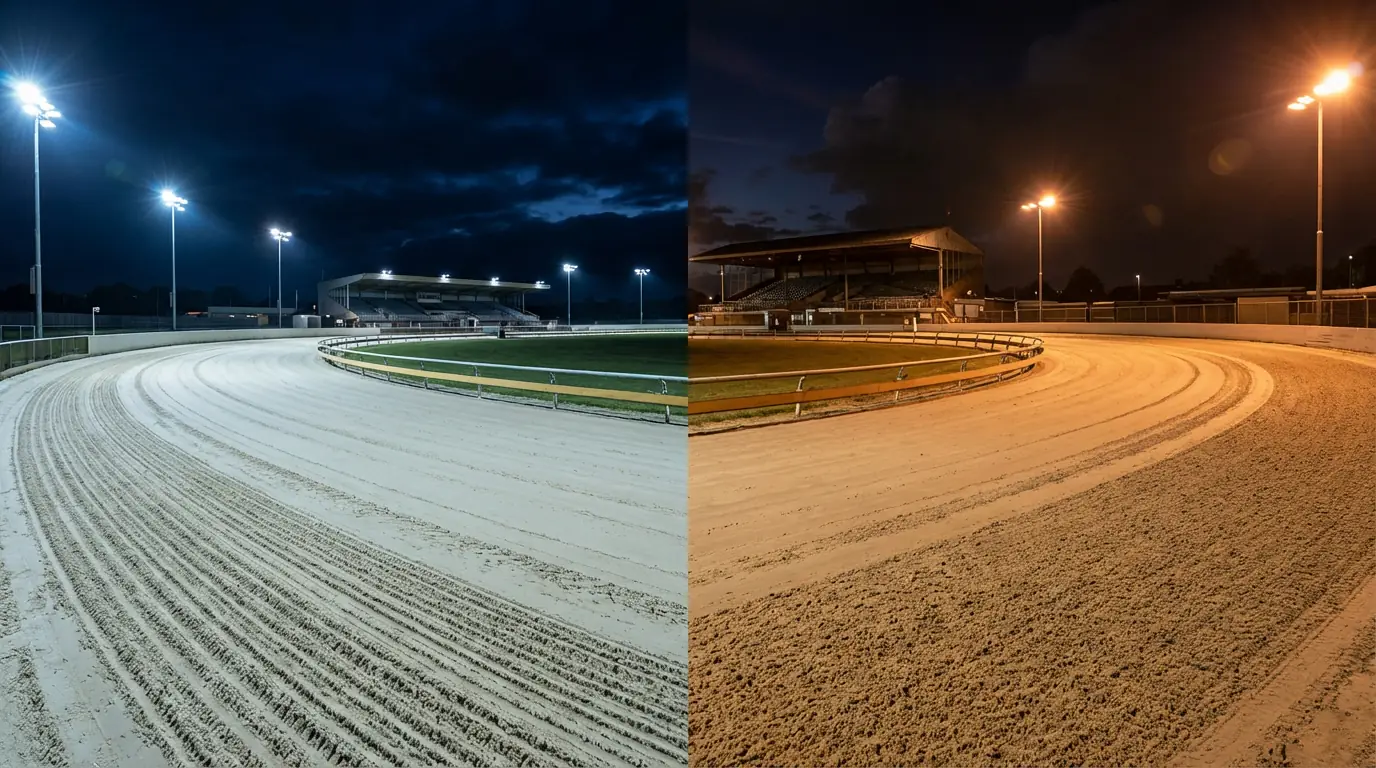
Towcester and Shelbourne Park are fundamentally different venues, and the dogs that excel at one do not always excel at the other.
Towcester is a purpose-built modern circuit in rural Northamptonshire. Its 500-metre race distance unfolds over a track with a circumference of approximately 420 metres, long straights, and sweeping bends. The surface is sand. The long run from the traps to the first bend — roughly 90 metres — gives dogs time to establish their position before the field compresses. This geometry rewards both early pace and wide runners, because the longer straight allows outside dogs to use their speed before the first turn. The bends themselves are relatively gentle, with clothoid transitions that reduce the centrifugal jerk on the dogs.
Shelbourne Park in Dublin is an older, tighter track. The circumference is smaller, the bends are sharper, and the run to the first bend is shorter. This geometry favours railers and dogs with sharp early speed — there is less time and less space for wide runners to establish their position before the first turn arrives. Dogs that rely on a wide running line at Towcester may find themselves squeezed at Shelbourne, where the tighter configuration demands faster reactions and more assertive early positioning.
The surface characteristics also differ. Towcester’s sand track plays differently depending on moisture levels and weather, but it is generally consistent in its effect on running times. Shelbourne’s surface has its own characteristics, and the times recorded at each venue are not directly comparable. A dog that clocks 29.50 at Shelbourne over 550 yards cannot simply be converted to a Towcester equivalent by adjusting for distance — the track geometry, surface, and bend curvature all influence the time in ways that simple arithmetic cannot account for.
For bettors assessing Irish runners at the English Derby, the venue translation is the critical analytical challenge. A dog with strong Shelbourne form is not automatically suited to Towcester. The trial at Towcester provides the first venue-specific data, and the seeding classification assigned after the trial may differ from the dog’s Irish profile. Pay close attention to trial performance and, where possible, compare the dog’s trial sectionals to its Shelbourne data rather than relying on headline times.
Draw System Comparison
The most significant structural difference between the English and Irish Derbys is the draw system. The English Derby uses a seeded draw under GBGB Rules 76 and 80, where dogs are classified as railers, middles, or wides and allocated to traps that match their running style. Railers go inside, wides go outside, and the randomisation occurs within each seeding category. The draw is structured to minimise the risk of dogs racing from positions that conflict with their natural style.
The Irish Derby uses a fully random draw. Dogs are allocated to traps without reference to their running style. A natural railer can draw Trap 6. A wide runner can draw Trap 1. The randomisation is complete and unconstrained by seeding categories. This produces a fundamentally different competitive dynamic: in the Irish Derby, trap allocation is a pure lottery, and every dog must be prepared to race from any position.
The implications for betting are substantial. In the English Derby, the draw is a variable you can partially predict and analyse before it happens — because you know that a railer will draw inside and a wide seed will draw outside, you can model the likely heat dynamics before the specific trap numbers are announced. In the Irish Derby, the draw is entirely unpredictable until it is published, and the analysis begins from scratch after the allocation.
Dogs that have contested the Irish Derby are therefore accustomed to racing from random traps. An Irish runner that won from Trap 5 at Shelbourne despite being a natural railer has demonstrated versatility that the English seeded draw does not require. That versatility is valuable — it suggests the dog can handle a suboptimal position if the English draw does not perfectly match its style. Conversely, a dog that has only raced in the Irish Derby may not have experienced the consistency of seeded allocation, and its first encounter with the English system may produce a race where it benefits from a better-matched trap than it has ever had.
Dogs Who Contested Both
The small number of greyhounds that have contested both the English and Irish Derbys in the same year — or across consecutive years — provide the most direct comparison between the two events. These dual-Derby runners are among the best of their generation, and their records illuminate the differences in what each competition demands.
Historically, the double has been attempted more often than it has been achieved. The logistics are demanding: a dog must peak across two separate competition cycles, often just weeks apart, while managing the physical toll of six-round elimination tournaments at different venues with different track characteristics. The Irish Derby traditionally runs in September, several months after the English Derby in May or June, which gives connections time to regroup — but the challenge of maintaining a greyhound at absolute peak performance across both events is considerable.
The most notable double winner in the modern era has been Tom’s The Best, who underlined his quality by winning both the English and Irish Derbys. His ability to adapt between Wimbledon and Shelbourne demonstrated the all-round versatility that the double demands. (Source: GBGB — Tom’s The Best) More recently, the distinction of running well in both events has belonged to a broader group of Irish-trained dogs, several of whom have reached the final of the English Derby after strong campaigns in Ireland, or vice versa.
For bettors, a dog’s record in both Derbys provides a rich dataset. If a dog reached the Irish final from a random draw at Shelbourne, you know it can handle adversity from an unfavourable position — useful context when assessing its prospects in the English Derby, where the seeded draw may give it a more natural trap. If a dog excelled at Towcester but struggled at Shelbourne, the venue translation is working against it — the tighter track and sharper bends may not suit its running style. Also read our Irish greyhounds in the English Derby.
The most valuable dual-Derby runners for analytical purposes are those who have run at both venues within the same year, because their form is contemporary and comparable. A dog that posted 28.70 at Towcester in June and then ran 29.60 at Shelbourne in September is not regressing — it is adjusting to a different venue, and the time difference reflects track characteristics rather than declining ability. Understanding this distinction prevents you from mispricing a dual-Derby runner based on superficial time comparison and allows you to assess its English Derby credentials with appropriate context.
