
Everything Happens in 30 Seconds
Greyhound racing is one of the simplest sports to understand and one of the most difficult to master. Six dogs chase a mechanical hare around an oval track. The first one across the line wins. A race lasts less than 30 seconds. There are no managers making tactical substitutions, no half-time intervals, no momentum shifts across 90 minutes. The traps open, the dogs run, and the result is final before most sports have completed their opening passage of play. Find more guides at greyhoundderbydraw.
That simplicity is what makes it accessible to newcomers. And the depth beneath that simplicity — the draw, the seeding, the form data, the track-specific variables — is what keeps experienced bettors engaged for decades. If you are new to greyhound racing, this guide covers the essentials: how a race works, how to read the racecard, what types of bets are available, and how to choose your first race.
How a Greyhound Race Works
A standard greyhound race in Britain features six dogs running over a fixed distance on an oval sand track. The most common race distances are 250 metres for sprints, 480 metres for standard races, and 500 metres for championship events like the English Greyhound Derby at Towcester. Some tracks offer longer distances for stayers, but six-dog racing over approximately 480 to 500 metres is the core product.
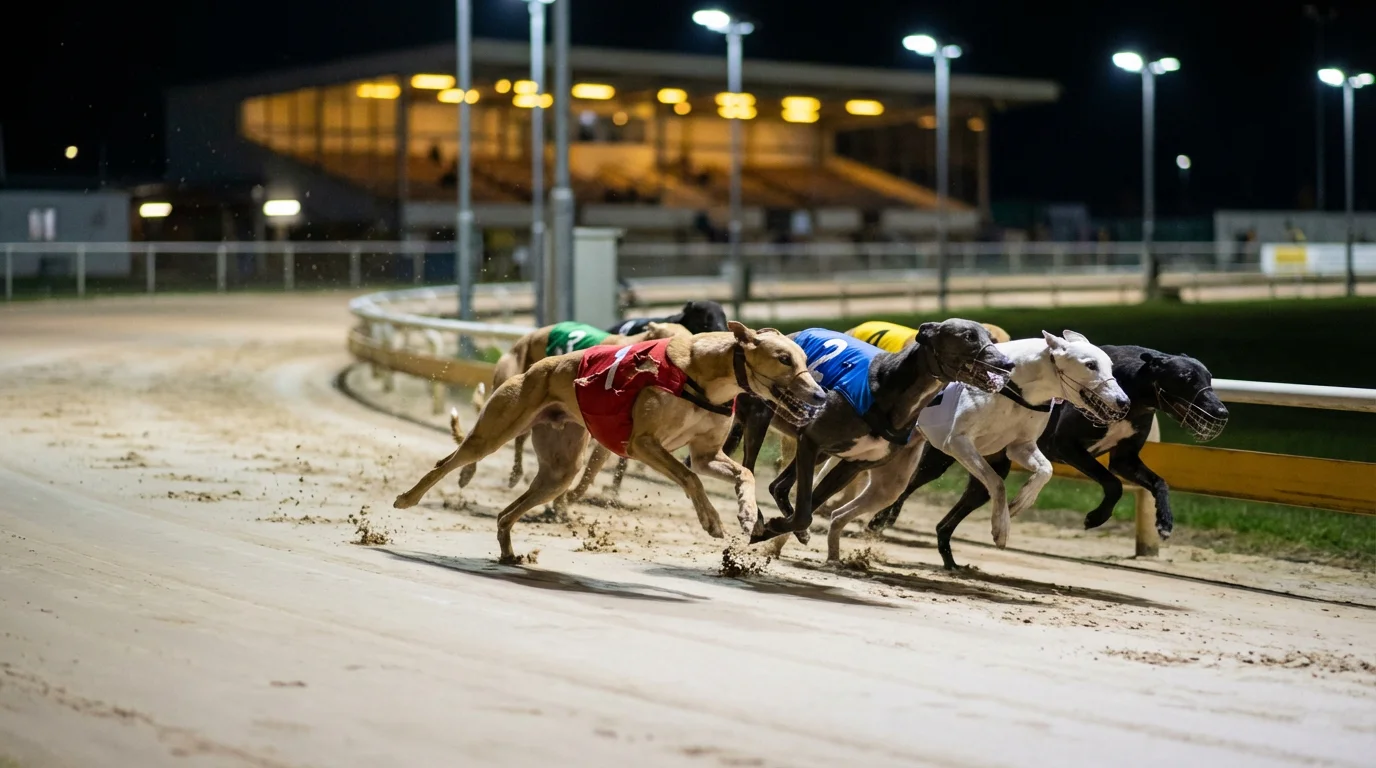
Each dog is assigned a starting trap numbered 1 through 6. Trap 1 is closest to the inside rail. Trap 6 is closest to the outside fence. The dogs wear coloured jackets corresponding to their trap number: red for 1, blue for 2, white for 3, black for 4, orange for 5, and black-and-white stripes for 6. These colours are universal across all licensed British tracks, so once you learn them, you can follow racing at any venue.
Before the race, the dogs are paraded for spectators and then loaded into the starting traps by their handlers. A mechanical hare — mounted on a rail that runs along the inside of the track — begins its run, and as it passes the traps, the lids spring open simultaneously. All six dogs accelerate out of the traps and chase the hare around the track. The hare maintains a lead of approximately 10 to 15 metres throughout the race and is not caught.
The race unfolds around the oval. The first critical moment is the first bend, usually reached within four seconds of the start. This is where the six dogs converge from a wide starting line into the narrower racing line of the turn, and the order established at the first bend often determines the final result. Dogs that reach the bend in front have the advantage of a clear run. Dogs caught in traffic behind them must find a way through, which costs time and energy.
After the first bend, the field sorts itself into running order through the back straight and the second bend. By the final straight — the run from the last bend to the finish line — positions are largely established, though fast-finishing dogs can still overhaul tiring leaders. The first dog to cross the line wins, and the official result is confirmed by the track’s photo-finish and timing systems. The entire race, from traps to finish, takes approximately 29 seconds over 500 metres.
The Racecard and Form
Every race has a racecard — a document listing the runners, their trap numbers, their recent form, and key statistics. The racecard is your primary analytical tool, and learning to read it is the first skill any greyhound bettor needs.
Each runner’s entry on the racecard includes: its name, trap number and jacket colour, trainer’s name, the dog’s weight in kilograms, and a string of form figures. The form figures are a sequence of numbers — such as 2-1-3-1-5 — representing the dog’s finishing position in each of its most recent races, with the leftmost number being the most recent. A “1” means it won. A “6” means it finished last. Letters indicate unusual events: “F” for a fall, “B” for brought down by another dog, and “D” for disqualified.
Below the form figures, you will typically find the time, distance, and venue for each recent race. A line might read “28.85 500m Tow” — meaning the dog ran 28.85 seconds over 500 metres at Towcester. This allows you to compare performances across runs and assess whether the dog’s form is improving, stable, or declining.
For beginners, the most useful racecard information is the recent finishing positions and the trap number. A dog with form figures of 1-1-2-1 has been consistently winning or placing, which suggests it is in good form. A dog with form of 5-6-4-5 has been finishing towards the back of the field and is unlikely to improve dramatically for a single race. The trap number tells you where the dog starts, and as you learn more about the sport, you will begin to understand which traps suit which running styles — but for your first few bets, focus on recent form and leave the draw analysis for later.
One piece of racecard information that beginners often overlook is the grade of each recent race. Greyhound racing operates a grading system where dogs are placed in races against others of similar ability. An A1 race features the highest-quality dogs at a track; an A10 race features the lowest. A dog winning comfortably in A6 grade is not the same as one scraping into third in A1. The grade contextualises the form figure and tells you the standard of competition the dog has been facing.
Types of Bets
Greyhound betting offers several different bet types, from the simplest single selection to more complex combination bets. As a beginner, starting with the straightforward options and building up to the more advanced types as your understanding grows is the sensible approach.
A win bet is the simplest: you pick one dog to win the race. If it finishes first, you collect your winnings at the quoted odds. If it finishes anywhere else, you lose your stake. Win bets are the foundation of all greyhound betting and the best place to start as a beginner.
An each-way bet is two bets in one: a win bet and a place bet. If your dog wins, both parts pay. If it finishes in a place position — typically first or second, sometimes first, second, or third depending on the bookmaker’s terms — only the place part pays, at a fraction of the win odds. Each-way bets cost twice the unit stake but offer a safety net if your dog runs well without winning.
A forecast bet requires you to predict the first two finishers in the exact order. A tricast extends this to the first three finishers. Both pay substantially higher returns than win bets because the difficulty is much greater. You can place a straight forecast or tricast, where you predict the exact order, or a combination version, which covers all possible orderings of your selected dogs at a proportionally higher stake.
Accumulator bets link multiple selections across different races into a single bet. All selections must win for the bet to pay out, but the odds multiply across each leg, producing potentially large returns from small stakes. Accumulators are popular during multi-race events like the Derby, where bettors might link selections across several heats on the same evening. The returns can be dramatic, but the strike rate is low — every additional leg reduces your probability of winning.
For your first greyhound bets, start with singles — either win bets or each-way bets at modest stakes. Learn what a winning selection looks like, how the odds translate to returns, and how the draw affects outcomes. Once you are comfortable with singles, you can explore forecasts and combination bets with a better understanding of what you are trying to predict.
Choosing Your First Race
If you are new to greyhound racing, the English Greyhound Derby is simultaneously the best and worst place to start. Best, because the Derby attracts the most media coverage, the most analytical content, and the most public interest of any greyhound event — resources that make learning easier. Worst, because the Derby’s six-round elimination format, seeded draw, and complex market dynamics are advanced topics that can overwhelm a beginner.
A better starting point is a standard evening card at any GBGB-licensed track. These meetings typically feature 10 to 12 races over the course of an evening, with a mix of grades and distances. The races are straightforward: six dogs, one race, one result. There is no multi-round strategy, no draw analysis beyond basic trap position, and no five-week narrative to follow. You place your bet, watch the race, and learn from the result.
When choosing your first race, look for a contest with a clear form standout — a dog whose recent form is visibly better than the rest of the field. A dog with form of 1-1-1-2 in A3 grade against a field of dogs with mid-table form offers a straightforward first bet. You are not trying to find a clever angle or exploit a draw advantage. You are betting on the most obvious selection in the race and seeing whether your reading of the form was correct.
Most licensed UK bookmakers offer live streaming of greyhound racing through their websites and apps, usually requiring a funded account or an active bet on the relevant race. Watch the race live if you can. Seeing how a greyhound race unfolds — the break from the traps, the first-bend dynamics, the finishing straight — teaches you more than any racecard can. After a few evenings of watching and small-stakes betting, the patterns become apparent: which traps tend to win at which tracks, how the first bend shapes the race, and what the form figures actually look like in motion. Also read our reading greyhound form for Derby betting.
Once you are comfortable with the basics, the Derby becomes a natural progression. You understand what the racecard means. You know how the traps work. You have seen enough races to recognise running styles and first-bend dynamics. The Derby adds complexity — the draw, the seeding, the round-by-round form trail — but it builds on a foundation that standard racing provides. Take the time to build that foundation before diving into the Derby’s deeper waters, and you will find the competition not just accessible but genuinely absorbing. The sport rewards attention, and the Derby rewards it most of all.
