
Numbers That Define the Standard
A track record is the fastest time ever recorded over a specific distance at a specific venue. It is the benchmark against which every subsequent performance is measured — the number that tells you what is possible on this track, under the best conditions, by the best dog. At Towcester, the 500-metre track record carries particular significance because it is the distance at which the English Greyhound Derby is contested. Every Derby heat, every semi-final, and every final is run over the same course that produced the record, and every time a dog finishes within a few tenths of it, the performance enters the conversation about the competition’s greatest runs. Get more race analysis at greyhoundderbydraw.
But track records are also among the most misused statistics in greyhound betting. They attract attention, generate headlines, and create market movements that are not always justified by what the number actually means. Understanding what a track record tells you — and what it does not — is essential for any bettor who wants to use time data accurately rather than impressionistically.
The Current Track Record
The 500-metre track record at Towcester was set by Barntick Bear at 28.52 seconds. That time was recorded during a standard graded meeting, not during the Derby, on a night when the sand surface was fast and the conditions were optimal. Barntick Bear was a high-class dog trained by Patrick Janssens whose early pace and sustained speed through the bends produced a performance that has not been bettered since.
The 28.52 represents the absolute ceiling of what is achievable over 500 metres at Towcester. To put it in context, a strong Derby heat-winning time is typically between 28.55 and 28.80, depending on going conditions. A time below 28.60 in any Derby race is exceptional. A time below 28.55 is historically rare and suggests a dog performing at the peak of its ability on favourable going. (Source: GBGB — Empress Stakes Report)
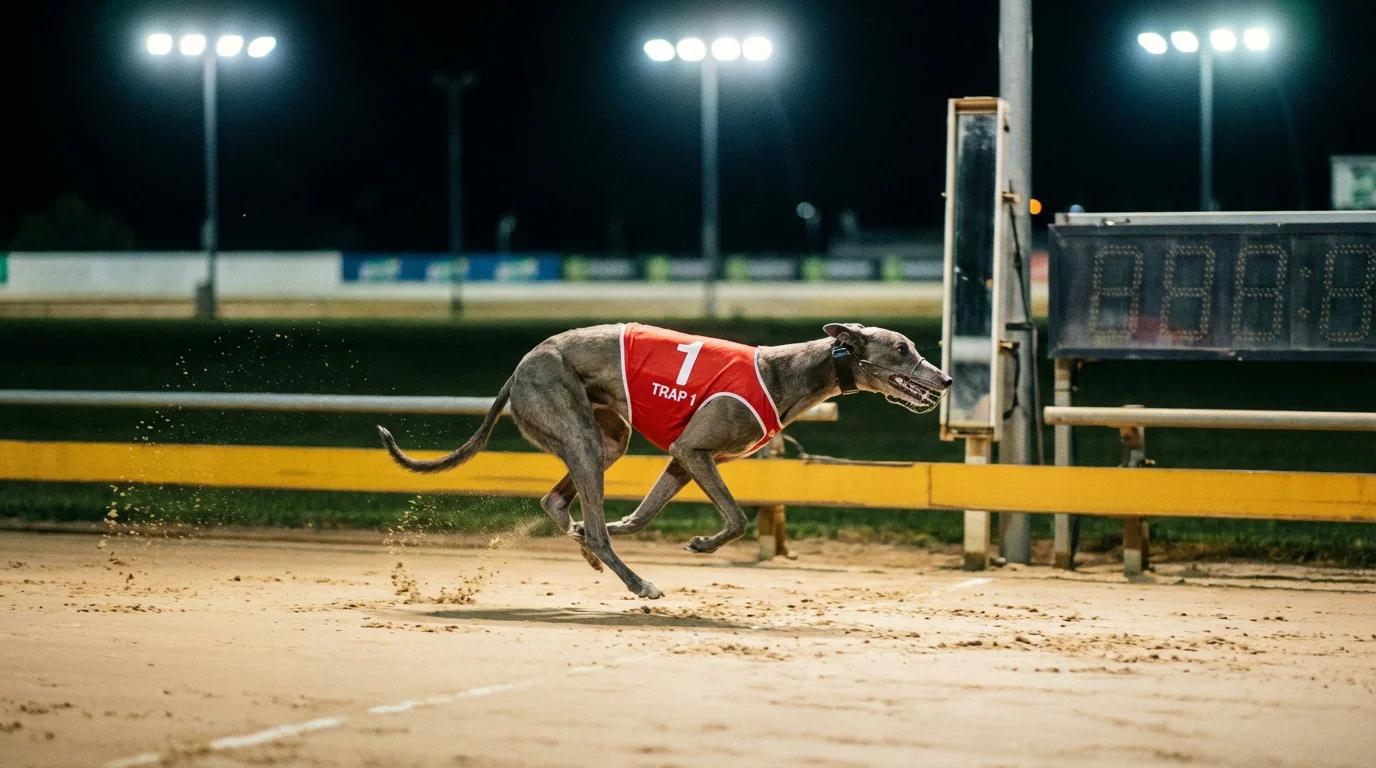
The record was set from Trap 1, which is relevant context. The inside trap offers the shortest racing line around the bends, and a dog that can exploit that line fully — breaking fast, securing the rail, and maintaining its inside position throughout — will record a faster time than a dog of equivalent ability running from a wider trap. Barntick Bear’s record reflects both his ability and his ideal starting position, and comparing times from wider traps against this benchmark requires an adjustment for the additional distance covered.
Track records at greyhound venues are not updated frequently. A record may stand for years, surviving through seasons of racing, different going conditions, and hundreds of dogs competing over the same course. The longevity of a record does not mean the track has become slower — it means that the specific combination of a top-class dog, perfect going, a favourable trap, and a clear run is rare. When it happens, the time that results is exceptional precisely because all variables aligned simultaneously.
Derby-Specific Fast Times
The fastest times recorded during the Derby do not always match the track record, and the gap between them is informative. Derby racing imposes constraints that standard graded racing does not: six-dog fields with high-quality opposition, competitive first bends, and the physical and mental toll of a multi-round elimination tournament. A dog running 28.60 in a Derby semi-final against five other serious contenders is producing a performance that is arguably more impressive than one running 28.50 in a low-key graded race with a clear lead throughout.
The fastest Derby final time at Towcester provides the competition-specific benchmark. This time — typically in the 28.60 to 28.80 range — reflects the quality of the six finalists, the draw dynamics on the night, and the going conditions on final Saturday. It is a more relevant reference point for assessing Derby contenders than the outright track record, because it measures performance under Derby conditions rather than optimal conditions.
Heat-level fast times during the Derby must be read with particular care. A dog that runs 28.55 in a first-round heat may have done so against moderate opposition on fast going, producing a time that flatters. The same dog might run 28.90 in round three against significantly better opposition on heavier going — a slower time that represents a superior performance. The raw number is identical in format but entirely different in meaning, and conflating the two leads to analytical errors that the market exploits.
Derby semi-final times are the most informative single-race data points in the competition. By the semi-finals, the going is established, the opposition is uniformly strong, and the dogs are at or near peak fitness. A fast semi-final time — below 28.70 — suggests a dog that is peaking at the right moment and has the speed to compete in the final. A slower semi-final time, from a dog that qualified comfortably without being extended, may disguise greater reserves. Both scenarios carry useful information, but neither should be taken at face value without contextual analysis.
What Track Records Mean for Betting
Track records and fast times influence the betting market, but they should not influence your betting in the way the market implies. A dog that runs close to the track record in a Derby heat will see its outright price shorten immediately. The market treats the time as a signal of superiority — and it may well be. But the signal is not as clean as the market assumes, and the price movement often overshoots the true value of the information.
The first problem is going adjustment. A time recorded on fast going cannot be directly compared to times on slower going. If the track record was set on a night when the sand was dry and firm, and a Derby heat produces a time within 0.10 seconds of it on identical going, that is genuinely impressive. If the Derby heat was run on different going — wetter, heavier, or freshly prepared — the comparison is invalid. The market sometimes makes this adjustment accurately and sometimes does not, particularly in the early rounds when the volume of heats makes detailed going analysis harder for traders.
The second problem is effort level. A dog running near the track record in a competitive heat was likely fully extended. That is useful — it tells you the dog’s peak speed. But a dog running well within itself in 28.85 might have the ability to run 28.55 under pressure. The track record is a ceiling; most performances are below it. Backing a dog whose time was close to the ceiling means backing a dog that was already near its maximum. Backing a dog with a slower time that has scope to improve means backing untapped potential, which the market consistently undervalues.
The practical approach is to use track record proximity as context, not as a selection criterion. A time within 0.30 seconds of the record suggests a dog with genuine class. A time within 0.15 seconds suggests an exceptional performance on the night. But neither number tells you whether the dog will run the same time next week, from a different trap, against different opposition, on different going. The track record sets the scale. Your analysis must fill in the details.
Records in Context
Track records exist in a broader context that affects how they should be interpreted. Towcester has hosted the Derby since 2017, and its 500-metre record has been set outside of the Derby itself. This is not unusual — track records at greyhound venues are often set during standard racing, because the conditions for record-breaking times (optimal going, clear run, inside trap, no competitive pressure) are more likely to align on a quiet Tuesday evening than on a pressurised Derby final night.
The Towcester record is also relatively young compared to records at tracks with longer histories. Venues like Romford, Nottingham, and the now-closed Wimbledon accumulated decades of racing data before their records settled. Towcester’s record may be broken as the venue matures and more high-class dogs race there. The current benchmark is a moving target, not a fixed monument, and bettors should treat it accordingly.
Cross-venue record comparison is meaningless in absolute terms. Towcester’s 500-metre record cannot be compared to Shelbourne Park’s 525-yard record or Nottingham’s historical figures, because the tracks differ in geometry, surface, and distance. A faster time at one venue does not indicate a superior performance to a slower time at another. Each record is venue-specific, and its value lies in comparing performances at the same track, under similar conditions, not in creating a league table of times across different circuits. Also read our greyhound racing sectional times.
For Derby bettors, the most useful relationship is between a dog’s current-round time and its previous times at Towcester during the same competition. A dog that runs 28.70 in round one, 28.65 in round two, and 28.60 in round three is on a trajectory of improvement. Whether those times are close to the track record matters less than the fact that they are progressively faster, suggesting a dog that is peaking as the competition intensifies. That trajectory — measured against the dog’s own benchmark rather than the venue’s — is the time-based insight that actually predicts future performance. The track record may set the ceiling, but the dog’s own trendline tells you which direction it is heading.
