
Where 192 Dogs Become 96
The first round of the English Greyhound Derby is the most chaotic, most unpredictable, and — for the prepared bettor — the most opportunity-rich stage of the entire competition. Approximately 192 greyhounds, drawn from kennels across the United Kingdom and Ireland, are divided into 32 heats of six runners. The top three in each heat qualify for the second round. The rest go home. Find more Derby guides at greyhoundderbydraw.
It is a brutal filter. Half the field is eliminated in a single weekend of racing, usually spread across three nights — Thursday, Friday, and Saturday. The quality range is enormous, from genuine Derby contenders to hopeful outsiders whose connections know they are there to make up the numbers. The draw is seeded but still produces heats of wildly varying quality, and the betting markets reflect that unevenness with prices that are, by the standards of later rounds, imprecise and exploitable.
If you are going to bet on the Greyhound Derby with any discipline, the first round is where your approach is established. What you learn from these 32 heats shapes every decision you make for the next five weeks.
First-Round Format
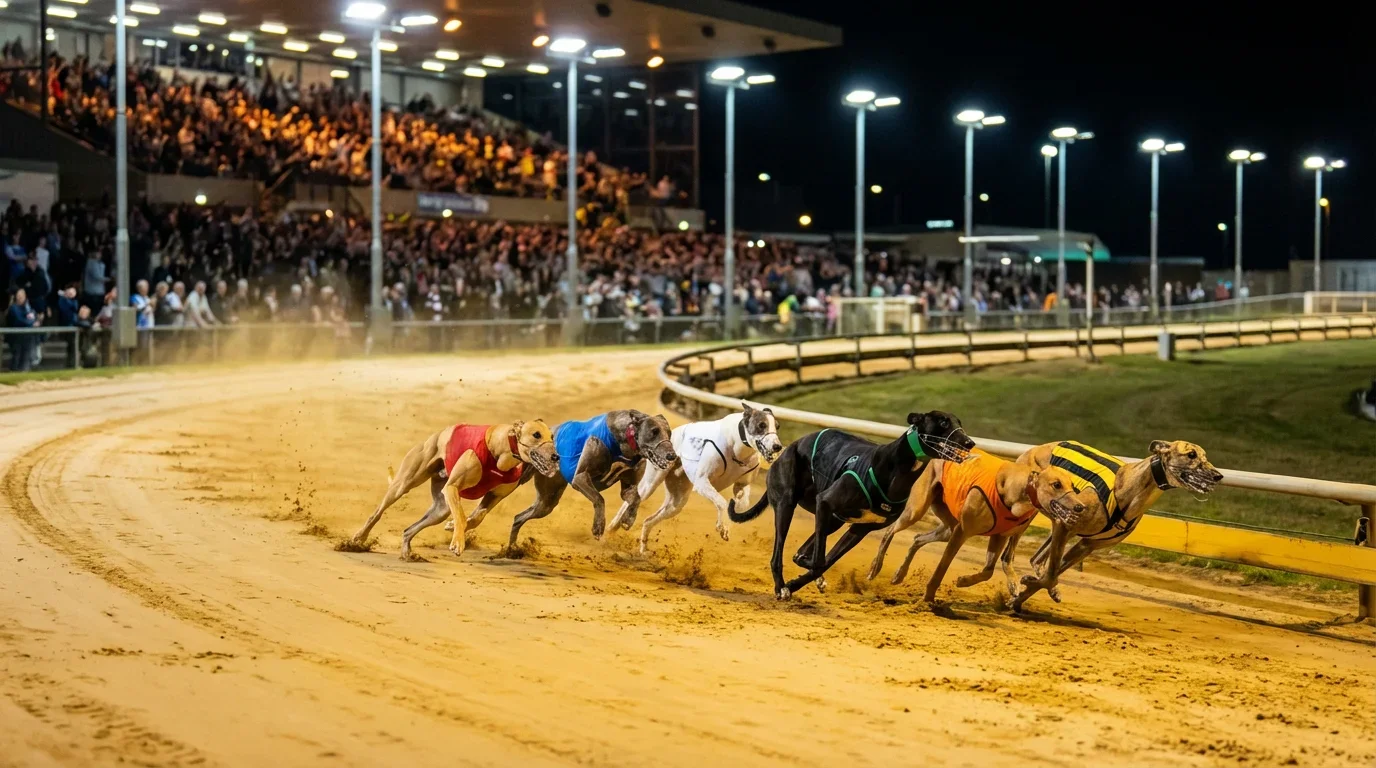
The first round is structured as 32 heats, each containing six greyhounds. The heats are spread across three consecutive evenings, typically running from Thursday to Saturday in the opening week of the Derby. Each heat is contested over the standard 500-metre Derby distance at Towcester, with the first three finishers qualifying for the second round.
The entry list is finalised in the weeks before the draw, with the 2025 renewal attracting 179 entries — 147 UK-trained runners and 32 from Ireland. Those entries are broken down by seeding: in 2025, there were 116 railers, 31 middle seeds, and 32 wide seeds. The draw distributes these dogs across the 32 heats according to GBGB Rule 80, which governs open-race trap allocation. Railers are drawn first, filling inside traps across the heats in sequence. Middle seeds are drawn next, followed by wide seeds.
The result is a series of heats that are seeded by running style but not by ability. A heat might contain the ante-post favourite alongside three dogs making their open-race debut. Another heat might pit four proven open-race performers against each other, creating a contest more competitive than some later-round races. This unevenness is not a flaw in the system — it is a structural feature that creates distinct opportunities at every stage of the first round.
Qualifying requires a top-three finish, not a specific time. A dog that wins its heat in 29.50 on a wet night progresses on exactly the same terms as a dog that records 28.60 on fast sand. This means that round-one times, while informative, must be read in context. The winning time is a product of the heat composition, the track conditions, and the dog’s effort level — not a pure measure of ability. A dog that qualifies comfortably in third place, having never been asked for maximum effort, may be saving more for later rounds than the flashy heat winner that was fully extended to win by a short head.
Draw Dynamics in 32 Heats
With 32 heats and roughly 192 dogs, the first-round draw is the most complex allocation of the entire Derby. The sheer volume means that unusual heat compositions are inevitable. Some heats will contain a disproportionate number of railers, leading to congestion on the inside. Others will feature multiple wide seeds, creating a different set of dynamics at the first bend. The draw cannot control for quality — only for running style — and this produces heats that range from foregone conclusions to genuine tactical puzzles.
The first thing to assess after the draw is heat quality. Scan the draw for heats where a heavily fancied dog has drawn against weak opposition. These heats often produce short-priced winners, but they also produce qualifying dogs whose prices in the next round will be inflated by an impressive-looking first-round performance that was, in reality, achieved against limited competition. Recognising these soft heats early allows you to calibrate your second-round assessments before the market does.
Equally, look for the horror heats — contests where three or four fancied dogs have been drawn together. These heats are where major Derby contenders can be eliminated before the competition has properly begun. They also produce the first round’s most spectacular racing and the most volatile betting opportunities. If you believe one dog in a horror heat is significantly better than the others, the market may be offering a longer price than its true ability warrants, simply because the heat looks competitive on paper.
Trap allocation in the first round is particularly significant because of the crowding dynamics. With six dogs in every heat and a mix of seedings, the inside traps can become congested in heats with multiple railers. A railer drawn in Trap 1 has a clean rail run, but a third railer in Trap 3 faces a crowded inside and may need to show more early pace than its form suggests to secure a clear passage. These positional nuances are where first-round draw analysis produces its biggest edges — not in identifying the heat winner, but in identifying which dogs will qualify comfortably and which will face unexpected obstacles.
Betting Angles for Round One
Thirty-two heats mean thirty-two opportunities — and bookmakers cannot price them all correctly. The first round of the Greyhound Derby is one of the few occasions in British greyhound racing where the volume of races overwhelms the market’s ability to set accurate prices. Traders must price 32 heats in a compressed timeframe, often relying on ante-post assessments and basic form rather than the detailed heat-by-heat analysis that a specialist bettor can undertake.
The primary angle is finding qualification value. In a race where the top three qualify, you do not need to identify the winner — you need to identify dogs that will finish in the first three. This is a fundamentally different assessment. A dog that is 5/1 to win its heat might be closer to 1/3 to qualify, especially if the bottom half of the heat is composed of clearly inferior runners. Each-way betting at enhanced place terms captures this qualification probability effectively, but so does simply backing the dog to win at a price that reflects its qualification likelihood rather than its winning chance.
The second angle is spotting draw-distressed favourites. A short-priced dog that has drawn a tough heat or a suboptimal trap will often drift in the market — sometimes beyond its true value. The market’s reaction to a bad draw can be excessive, particularly for dogs whose class is high enough to overcome positional disadvantage. If you assess that a 4/6 favourite whose price has drifted to 6/4 after a difficult draw is still the most likely qualifier from its heat, that drift represents value.
The third angle is the opposite: ignoring impressive first-round performances that are context-dependent. A dog that breaks the track record in a first-round heat gets attention, but if that heat contained five moderate opponents and the dog was never challenged, the time flatters. Bookmakers and punters both tend to overweight flashy times in the first round, creating inflated prices for the beaten dogs and compressed prices for the winner going into round two. If you can separate genuine ability from context-boosted times, you will find value on both sides.
Finally, consider lay opportunities if you use betting exchanges. First-round favourites that have been heavily supported ante-post sometimes start at prices that assume qualification is a formality. If the draw has produced a tougher heat than the market has accounted for, opposing the favourite at odds-on can be a sharp play — not because the dog cannot qualify, but because the probability of elimination is higher than the price implies.
All of these angles, however, depend on one thing: reading the available data accurately. And the most misread data point in the entire first round is the finishing time.
What Round One Times Really Mean
First-round times dominate the post-race conversation. Social media lights up when a dog clocks 28.60 on opening night. Ante-post markets move. The narrative forms around which dogs ran fast and which dogs did not. But interpreting round-one times requires more scepticism than most punters apply.
The first problem is track conditions. The three nights of first-round racing often produce different going conditions — Thursday’s sand may be freshly prepared and fast, while Saturday’s surface has been raced on twice and rides slightly slower. A dog recording 28.80 on Saturday might have run the equivalent of 28.60 on Thursday’s track. Without adjusting for going, direct time comparisons between heats on different nights are misleading.
The second problem is effort level. A class dog in a weak heat does not need to run fast. It breaks well, leads to the first bend, and controls the race without ever reaching top gear. Its time might be 29.10 — unremarkable on paper, but achieved at 80% effort. The same dog, fully extended in a tougher heat later in the competition, might clock 28.50. The slow first-round time was not a sign of weakness; it was a sign that the dog did not need to try. Trainers know this. Experienced punters know it too. The market, collectively, often forgets it.
The third problem is sectional context. Overall time is the product of early pace and finishing speed, and a fast time can come from different sectional profiles. A dog that records a blistering first split of 3.90 seconds to the first bend but fades slightly in the run-in has a different profile from a dog that splits 4.10 but powers home. Both might finish in 28.70, but their running styles — and their prospects in later rounds — are quite different. The first dog needs a clear lead to exploit its early pace. The second dog can come from behind. In later rounds, where the competition is stiffer and clear leads are harder to establish, the finishing-speed dog often has the edge. Also read our greyhound Derby rounds full breakdown.
The practical takeaway is this: use first-round times as a starting point, not a conclusion. Note the raw time, then adjust for going, heat quality, effort level, and sectional profile. A dog that qualifies in a modest time from a tough heat after being checked at the first bend is often a better Derby prospect than a dog that recorded a headline time against limited opposition with a clear run throughout. The first round produces data. Interpreting that data correctly — rather than taking it at face value — is what separates a systematic bettor from the crowd.
