
Three Tags, Three Racing Lines
Every greyhound enters the Derby wearing an invisible label. Before a single trap springs open, before any ante-post price is set, the dog has already been classified by the Greyhound Board of Great Britain into one of three seeding categories: railer, middle, or wide. That classification determines which trap it can be drawn into — and by extension, how its race will unfold. Find more trap analysis at greyhoundderbydraw.
Seeding is the mechanism that connects a greyhound’s natural running style to its starting position. It is not random. It is not cosmetic. It is the single most important structural feature of the English Greyhound Derby draw, and yet it remains one of the least understood aspects of the sport among casual bettors. A dog’s seeding tag dictates its trap range in every round, shapes the competitive dynamics of each heat, and creates measurable advantages and disadvantages that directly affect race outcomes and betting value.
The system exists for fairness and safety — placing a natural inside runner in an outside trap, or vice versa, increases the likelihood of crowding and interference at the first bend. But its consequences extend well beyond welfare. If you want to read a Derby draw with any precision, you need to understand what railer, middle, and wide actually mean, how each classification is assigned, and what happens when the seeding does not quite match reality.
Railers: The Inside Line
Railers hug the inside rail — and that is both their strength and their limitation. A greyhound classified as a railer is one whose natural racing line takes it to the inner part of the track from the moment the traps open. These dogs break left, seek the rail, and run tight to the inside around the bends. In British greyhound racing, railers are issued a “rails tag” and are drawn into the lowest available trap numbers within their heat.
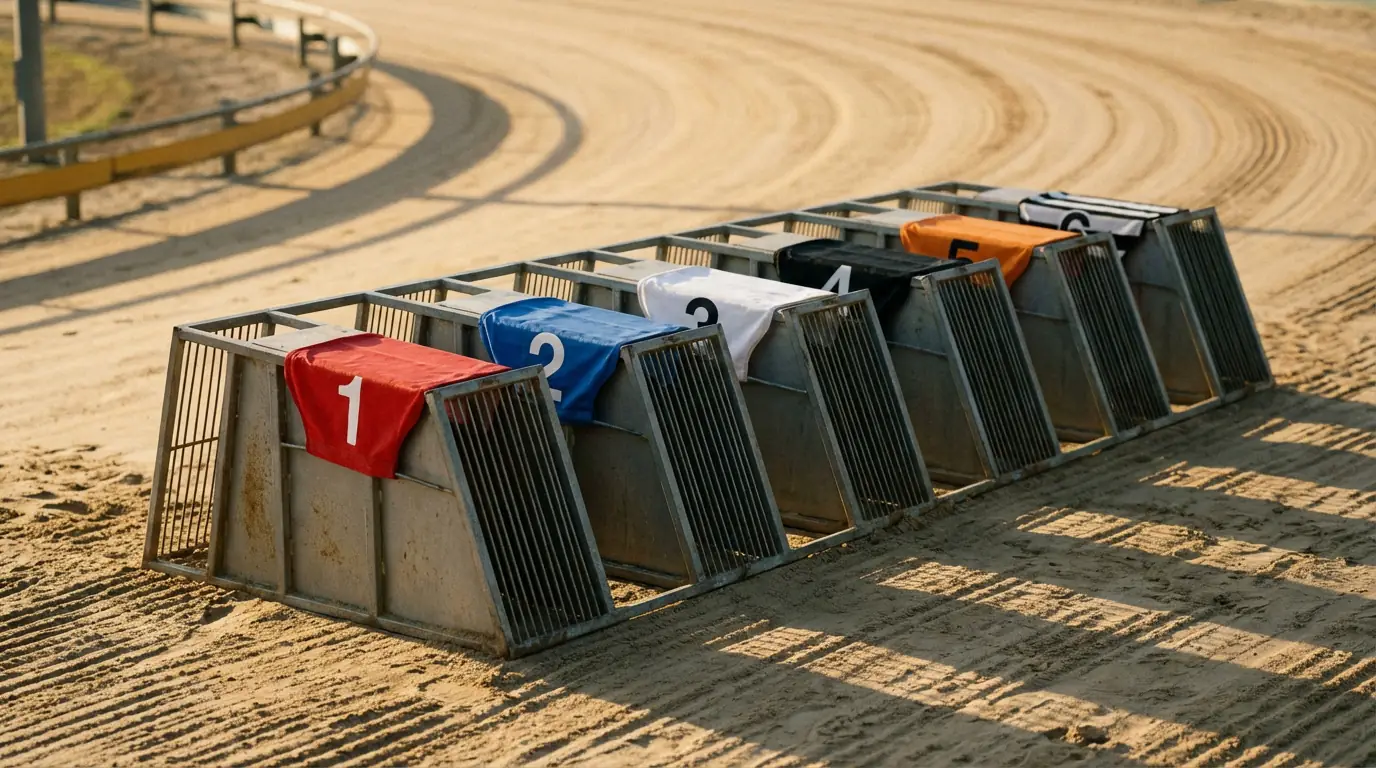
Under GBGB Rule 76, which governs graded race trap allocation, the first railer drawn in any heat occupies the first available inside trap — typically Trap 1. The second railer takes the next inside position, and so on. This means railers consistently race from the red or blue jacket, starting closest to the rail and the hare’s running path. The advantage is obvious: a shorter racing line around the bends translates to less ground covered over 500 metres. At Towcester, where the circumference is 420 metres and the race distance is 500 metres, the geometry rewards inside runners who can maintain their line without being pushed wide.
But the limitation is equally real. Railers depend on a clean break from the boxes. If a railer is slow to emerge, the dogs on its outside can cut across its running line at the first bend, forcing it to check, lose momentum, or take a wider path than its natural style demands. In first-round heats of the Derby, where six dogs contest each race and multiple railers can be present, the inside traps can become congested. Two railers drawn side by side will both seek the same strip of track within the first 50 metres, and only one of them can have it.
Identifying a railer is not always straightforward from the racecard alone. The classification is typically assigned after a greyhound’s trial at the competition venue. A racing manager observes the dog’s behaviour during the trial — which part of the track it gravitates towards, how it handles the bends, where it settles in an open gallop — and assigns the appropriate tag. Dogs that have raced extensively at a particular track will already carry a seeding based on their graded form, but a trial can override that assessment if the dog’s behaviour at the Derby venue differs from its usual pattern.
For bettors, the key consideration with railers is trap dependence. A railer from Trap 1 has every advantage its style demands. A railer drawn into Trap 3 — perhaps because the heat already has two higher-priority railers — is at a structural disadvantage. It must still seek the rail, but now it has to navigate around or through two dogs that are already closer to it. That distinction is often worth more than a length at the first bend, and it should be reflected in how you price the dog’s chances.
Middle Seeds and Wide Seeds
Middles and wides occupy the traps that railers do not. A middle seed is a greyhound whose natural running line takes it between the rail and the outside fence — it does not commit fully to either side of the track. These dogs are given a “middle tag” and under the current GBGB rules, they are drawn into the first available position next to the nearest inside runner in the heat. In practice, this usually means Traps 3 or 4, depending on how many railers are already allocated.
Wide seeds are the opposite end of the spectrum. These dogs naturally run towards the outside of the track, carrying their pace around the bends on a wider arc. They are drawn last in the allocation sequence, filling the remaining outside positions — typically Traps 5 and 6. The wide seed’s advantage is clear space: with no dog on their outside, they face less interference at the first bend and can commit to their running line without adjustment. The trade-off is distance. A wide runner covers more ground on every bend, and over 500 metres that adds up.
The middle seed classification is perhaps the most tactically interesting of the three. Middles are neither committed to the rail nor the fence. They have the flexibility to break either way depending on the pace around them, and at the first bend they can adapt to whatever traffic pattern emerges. This versatility makes them harder to predict from a draw perspective — a middle seed in Trap 3 might race like a railer if the inside is clear, or shift wide if the two traps inside it are occupied by fast-breaking dogs. For bettors, middle seeds require the most contextual analysis. Their draw allocation matters, but the identities and early pace profiles of their neighbours matter more.
Wide Seeds at Towcester — the Hidden Edge
Towcester’s track geometry gives wide seeds an advantage that previous Derby venues never offered to the same degree. The long run from the traps to the first bend — approximately 90 metres of straight — means that wide seeds have time to establish their position before the field compresses into the turn. At Wimbledon, where the run to the first bend was shorter, wide seeds had less time to use their early pace and often found themselves swept into trouble before they could establish their line.
At Towcester, the data tells a different story. Wide seeds have featured prominently in Derby finals since the move to Northamptonshire. The 2025 final saw Bockos Diamond, a wide seed, drawn into Trap 6 — a position perfectly suited to his running style, just as it was in the semi-finals. However, despite leading for much of the race alongside kennelmate Bombay Pat, the two Holland-trained runners compromised each other, and it was Droopys Plunge — a railer drawn in Trap 1 — who exploited the inside rail to finish strongest and win by a length and a half. The result demonstrated that while Towcester’s geometry gives wide seeds genuine opportunities, the final remains unpredictable.
This is not to suggest that wide seeds are always favoured at Towcester. They still cover more ground, and on a night where the sand is wet and heavy, that extra distance costs more in terms of energy. But the structural advantage is genuine: at this venue, being drawn wide is not the disadvantage it was at Wimbledon. For bettors, that means treating wide seeds in Traps 5 and 6 at Towcester with considerably more respect than their historical Derby records might suggest.
How Seeding Shapes Your Bet
If a railer draws Trap 4, something is wrong — and your bet should reflect it. The entire point of the seeding system is to match a dog’s running style to its starting position. When that match breaks down, the dog is structurally disadvantaged before the race begins. Conversely, when a dog’s seeding and trap are perfectly aligned, a significant source of race-day uncertainty is removed.
The first thing to check after any draw is whether each dog’s seeding matches its trap allocation. In a well-structured heat, the railers will be in Traps 1 and 2, the middles in 3 and 4, and the wides in 5 and 6. That is the ideal configuration. But it does not always work out that way. If a heat contains four railers and only one wide, the allocation shifts: some railers will end up in middle positions, and the single wide seed might occupy Trap 5 rather than 6. These structural dislocations create mismatches — and mismatches create betting opportunities.
A railer forced into Trap 3 or 4 must cross traffic to reach its preferred line. That crossing takes time and carries risk. If the dogs on its inside are quick to break, the misplaced railer may never reach the rail at all, spending the entire race on an unfamiliar line. Bookmakers do not always account for these dislocations in their pricing, particularly in early rounds when 32 heats need to be priced quickly. A dog whose form reads well but whose seeding conflicts with its trap is often overpriced — which is exactly the scenario a sharp bettor should be looking for.
The reverse also applies. A wide seed drawn into Trap 6 with an empty Trap 5 beside it has a structural free run to the first bend. If that dog also has strong early pace, the combination of clear space and natural running line makes it extremely difficult to beat. These are the draws where the market often gets it right, but sometimes does not get it right enough — the dog shortens from 3/1 to 2/1, when the true probability of winning, given the draw alignment, is closer to even money.
The practical rule is straightforward: always assess the gap between a dog’s seeding and its actual trap before consulting form, times, or trainer records. If the seeding fits, you are betting on the dog’s ability. If it does not fit, you are also betting on the dog overcoming a structural obstacle — and that should cost more in your assessment.
The Tag Is the Starting Point, Not the Answer
Dogs evolve. Seedings do not always keep up. A greyhound that raced as a committed railer throughout its graded career might develop a wider running style after several rounds of open-race competition. The Derby itself, with its six consecutive rounds of high-pressure racing, often forces dogs to adapt. A railer that encounters crowding in round one might learn to break wider in round two. A wide seed that discovers it can hold the inside at Towcester might start racing on a tighter line than its tag suggests.
This is where attentive bettors gain an edge over those who simply check the seeding column and move on. Watch the races. Note where each dog actually runs, not just where its classification says it should run. A dog whose behaviour is drifting away from its official seeding is a dog whose draw allocation may not reflect its current racing reality — and that discrepancy can persist for an entire round before the racing manager adjusts the tag, if adjustment happens at all. Also explore our greyhound seeding guide.
Seeding is the foundation of the Derby draw. It determines trap allocation, shapes heat composition, and creates the structural framework within which every race is contested. But it is a snapshot, not a live feed. The tag tells you where the system thinks the dog belongs. What the dog actually does with its trap, once those lids fly back, is a different question entirely. That gap — between classification and performance — is where the draw stops being a mechanical exercise and starts becoming a betting edge.
