
Not All Traps Are Equal
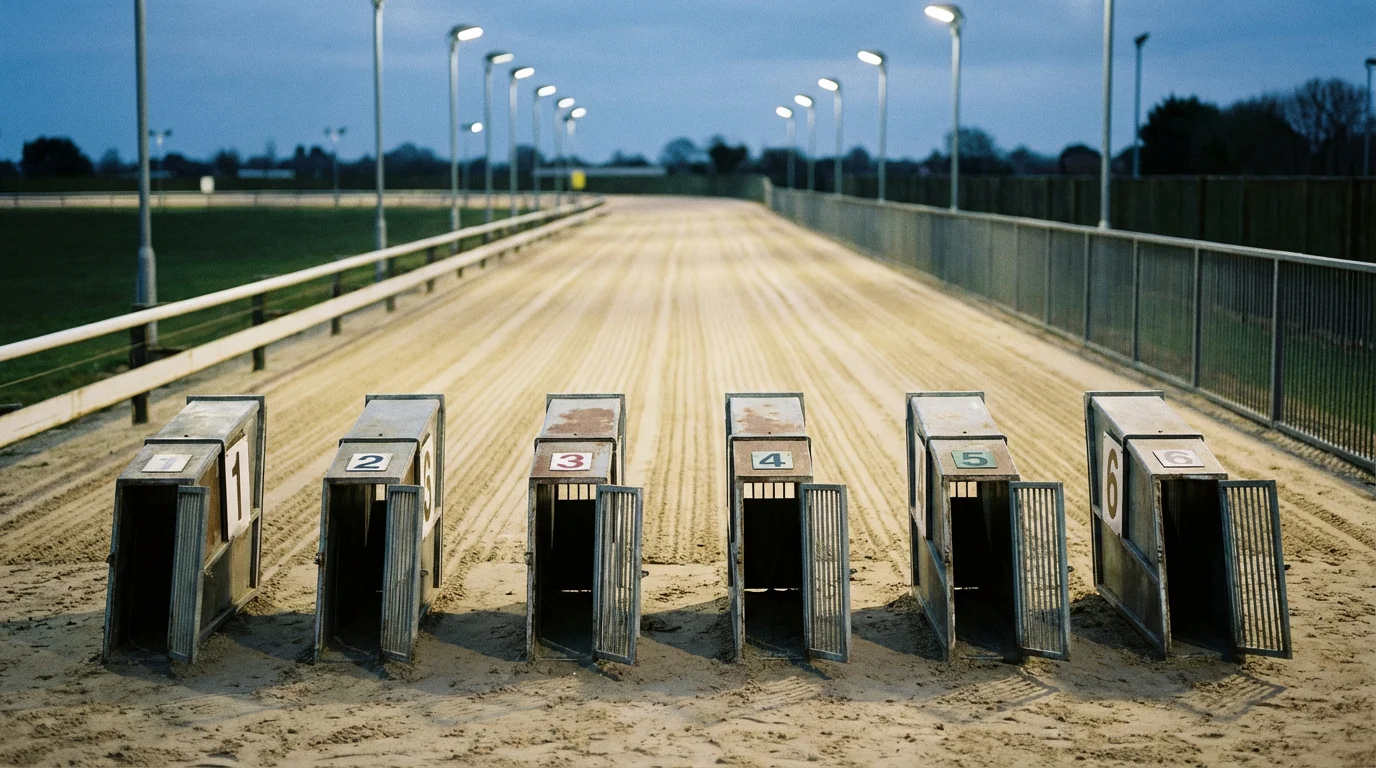
In six-dog racing, starting position is the only variable you can see before the traps open. You cannot predict the weather with certainty, you cannot know how a dog will feel on the night, and you cannot anticipate the precise dynamics of the first bend. But you can look at a racecard, see that your fancy is in Trap 3 rather than Trap 1, and make an informed assessment of what that means for its chances. Find more trap analysis at greyhoundderbydraw.
Trap position influences greyhound racing at every level — from Monday night graded meetings at provincial tracks to the English Greyhound Derby final at Towcester. The influence is not uniform, not absolute, and not the same at every venue. But it is measurable, and over a large enough sample, it is consistent. Dogs drawn on the inside have shorter runs around the bends. Dogs drawn on the outside have more clear space at the start. Dogs drawn in the middle inherit the problems of both positions and the advantages of neither.
The question for any bettor is not whether trap position matters — it does — but how much it matters relative to everything else. And the answer depends on which track you are looking at, which round of competition is being contested, and which dogs are in the adjacent traps.
The Physics of the First Bend
What happens in the first four seconds determines most race outcomes. From the moment the lids fly back, six greyhounds accelerate towards the first bend — and the geometry of that turn creates a compression point that separates winners from also-rans. Understanding why trap position matters requires understanding the physics of that bend.
A greyhound racing track is an oval. The bends are semi-circular, with the inside rail describing a tighter arc than the outside fence. A dog running on the rail covers less distance than a dog running wide. At Towcester, where the circumference is 420 metres, the difference between the inside and outside racing lines on a single bend is roughly three to four metres. Over two bends in a 500-metre race, that amounts to six to eight metres — approximately half a length in greyhound racing terms.
That geometry alone favours inside runners. But it is only half the story. The first bend also creates a crowding problem. Six dogs are converging from a starting line into a space that narrows as the bend begins. The dogs on the inside have the shortest path, but they are also the most vulnerable to interference. If a dog from Trap 3 or 4 breaks faster than the dogs inside it, it can cut across their running line and force them to check — losing far more than the geometric advantage they held.
Centrifugal force compounds the issue. As greyhounds enter the bend at speed, the outward force pushes them towards the outside of the track. Dogs that are already running wide feel this less — they are running a gentler curve. Dogs on the rail experience more abrupt curvature changes, especially if the track’s transition from straight to bend is sharp rather than gradual. Research published in Scientific Reports has shown that clothoid curve transitions — where curvature increases gradually — significantly reduce the jerk forces on greyhounds and lower injury rates. Tracks without these transitions punish inside runners disproportionately.
The practical consequence is this: the inside traps offer a geometric advantage but carry a higher risk of interference. The outside traps concede distance but gain clear running space. The middle traps inherit congestion from the inside and the wider arc from the outside. Each position demands a different set of attributes from the dog occupying it, and the best trap for any given greyhound depends on whether its racing style matches the demands of that starting position.
Track-by-Track Trap Bias
Bias varies by venue — a Trap 1 specialist at Romford might struggle at Towcester. Every track has its own geometry, its own surface, its own run to the first bend, and its own idiosyncratic patterns of trap advantage. What holds true at one venue may be misleading at another, and bettors who apply a single set of trap assumptions across all tracks are making a fundamental error.
At Towcester, graded racing data shows that Trap 1 produces winners at approximately 20% of the time — a respectable but not dominant figure. The long run to the first bend gives inside runners time to establish their line, but it also gives outside runners time to build pace and assert their position. The result is a relatively flat trap bias compared to tighter tracks where inside traps dominate. Trap 6 at Towcester performs well above the national average for outside positions, reflecting the venue’s wider first turn and the advantage of clear space on the outside.
Compare this to Harlow, where Trap 6 carries a strike rate above 21% — significantly higher than most tracks. Harlow’s track configuration favours early-pace dogs on the outside, and the data reflects it. At Romford, a tight inner-city track with sharp bends, Trap 1 historically outperforms, because the geometry punishes wide runners on every turn. At Nottingham, which hosted the Derby in 2019 and 2020, the bias profile was different again — wider bends and a longer circuit rewarded dogs with sustained pace rather than sharp early speed.
For Derby bettors, the relevant venue is Towcester, and the relevant question is always: what does this trap mean at this track? A dog drawn into Trap 1 at Towcester is not in the same position as a dog drawn into Trap 1 at Romford, even if the racecard looks identical. The track’s geometry mediates the trap’s value, and any serious analysis must account for venue-specific data rather than generic assumptions about inside versus outside positions.
The sample size issue complicates matters further. Towcester has hosted seven Derby renewals as of the end of 2025, producing seven finals. Seven data points for each trap in the final is not enough to draw statistically robust conclusions. Heat-level data from those seven years is more useful, but it still represents a fraction of the total sample available from Wimbledon’s three-decade run. Smart bettors use Towcester-specific data where available but remain aware that the picture is incomplete.
How Bettors Should Weight Trap Position
Trap position is a modifier, not a verdict. It adjusts the probability of a dog winning without overriding the fundamentals of form, fitness, and class. A good dog in a bad trap will still win more often than a bad dog in a good trap. But a good dog in a good trap wins more often than either — and that incremental advantage is where betting value lives.
The first step is to assess whether the trap allocation matches the dog’s seeding. A railer in Trap 1 is in its natural position. A railer in Trap 3 faces a structural challenge. A wide seed in Trap 6 has clear space. A wide seed in Trap 4 is compromised. These are the baseline assessments, and they should inform your initial view of the draw before you consider anything else.
The second step is to assess the neighbours. Trap position does not exist in isolation — its value depends on who is alongside. A dog in Trap 2 with a fast-breaking railer in Trap 1 faces a different proposition than a dog in Trap 2 with a slow starter inside it. The racecard gives you this information: check the early pace figures, the sectional times, and the recent trap history of every dog in the heat. A trap that looks neutral on paper can become advantageous or problematic depending on the specific combination of dogs around it.
The third step is to consider the round context. In first-round heats, where the field is at its largest and the allocation is at its most random, trap position has less predictive power — the sheer number of heats means that unusual heat compositions are inevitable, and the draw has not yet been refined by progressive elimination. By the semi-finals and the final, every trap allocation is scrutinised, every neighbour relationship is analysed, and the market reflects it. Value from trap position in the later rounds comes not from the position itself but from disagreements about how much that position matters given the specific dogs involved.
The weight you assign to trap position should scale with the information available. In early rounds, use it as one input among several. In the final, treat it as a primary factor — because in a six-dog race between evenly matched greyhounds, the trap can be the difference between winning and finishing third.
The Trap Tells You the Question, Not the Answer
Every race tells its own story — the trap just sets the scene. A Trap 1 draw does not guarantee a rail-hugging victory any more than a Trap 6 draw guarantees isolation on the outside. What the trap does is establish the parameters within which the race will be contested: which running lines are available, where congestion is likely, and which dogs will need to overcome positional disadvantage to win.
The best use of trap position data is not as a selection tool but as a calibration tool. It helps you adjust the probability you assign to a dog’s chance of winning, nudging it up or down depending on whether the draw complements or conflicts with the dog’s natural style. That adjustment might be small — a couple of percentage points in most cases — but in a betting market where margins are thin, a couple of percentage points consistently applied adds up to a significant edge over time. Also explore our how trap position affects racing results.
Treat the trap as context, not conclusion. Build your assessment on form and fitness, then adjust for draw. The dog that wins is not always the one with the best trap. But the dog with the best trap starts the race with one fewer problem to solve — and in a sport decided by lengths and fractions of a second, that matters more than most punters give it credit for.
