
Predicting the Order, Not Just the Winner
A win bet asks you to identify one dog. A forecast asks you to identify two — in the correct finishing order. A tricast asks for three. The difficulty scales exponentially, and so do the returns. In a six-dog Derby heat, a winning forecast can pay ten to twenty times the equivalent win price, and a tricast can return multiples of a hundred times stake on a race that lasts less than thirty seconds. Find more bet type guides at greyhoundderbydraw.
Forecast and tricast bets are a natural fit for greyhound racing precisely because the fields are small. With only six runners, the number of possible combinations is manageable — 30 possible forecasts and 120 possible tricasts — compared to the hundreds or thousands of permutations in a full horse-racing field. This makes the analysis tractable, the draw directly relevant to the finishing order, and the rewards disproportionately large when you get it right.
But getting it right requires a different analytical approach from simply picking a winner. You need to think about the race as a sequence of positions, not a single outcome, and the draw is the tool that helps you model that sequence.
Forecast Betting Explained
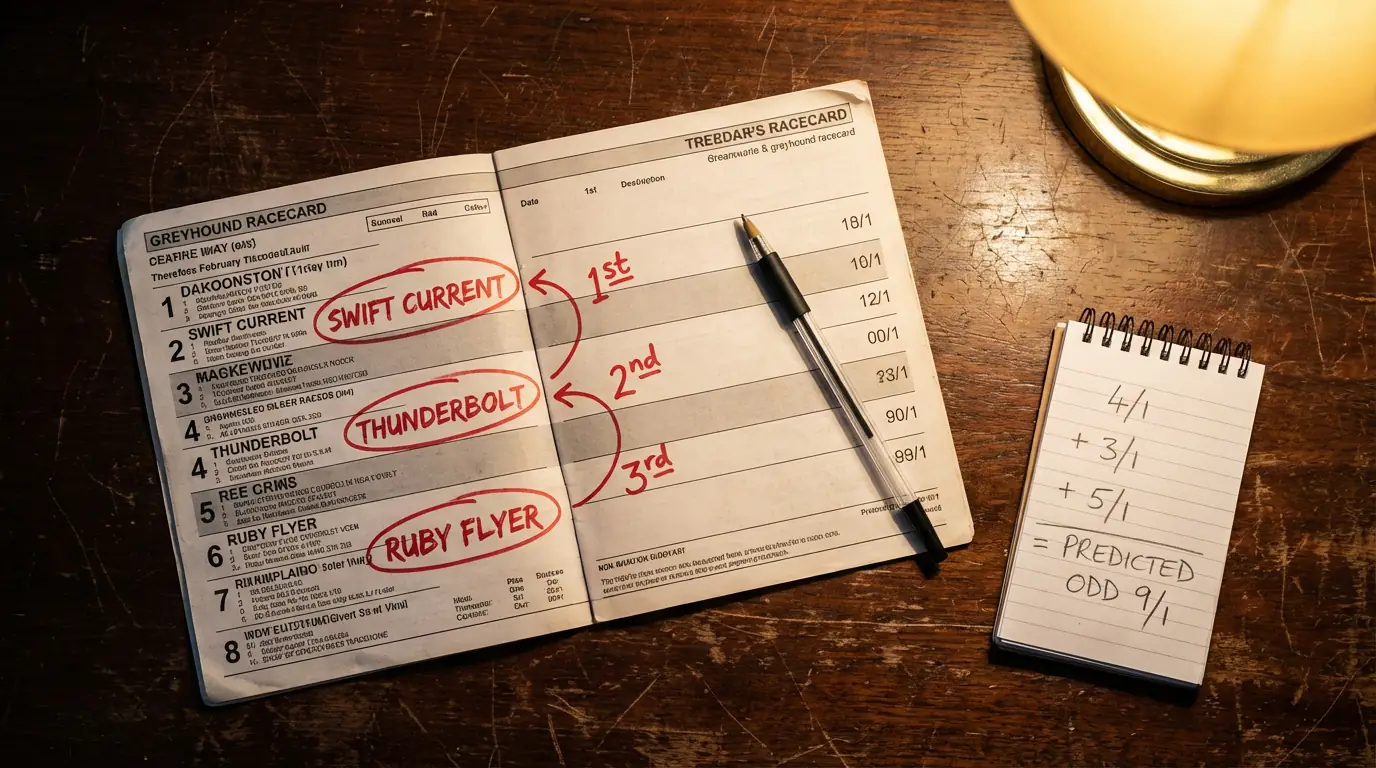
A forecast bet requires you to predict the first two finishers of a race in the exact order. You nominate one dog to finish first and another to finish second. If both dogs finish in those precise positions, the bet wins. If either finishes in a different position — including if they swap places — the bet loses.
There are two main types of forecast. A straight forecast is the basic version described above: Dog A first, Dog B second. A reverse forecast covers both permutations — Dog A first and Dog B second, or Dog B first and Dog A second — but costs twice the stake because it is effectively two bets. The reverse forecast increases your chance of winning but halves the value per unit staked.
In greyhound racing, forecast bets are settled at a declared dividend calculated by the totalisator, not at fixed odds. The dividend depends on the number of bets placed across all possible forecast combinations and the proportion of the pool allocated to the winning combination. In practice, this means you do not know the exact payout until after the race. You can estimate it based on the win odds of the two dogs involved — the longer-priced the pair, the higher the forecast dividend — but the actual return depends on the pool distribution on the night.
Some bookmakers also offer fixed-odds forecasts, where the price is quoted before the race and does not change with pool fluctuations. Fixed-odds forecasts give you certainty on returns but are typically less generous than pool dividends because the bookmaker builds in a wider margin. During the Derby, when pool sizes are larger than a typical Tuesday evening card, tote-pool forecasts often produce better dividends than their fixed-odds equivalents.
The analytical requirement for forecast betting is straightforward but demanding: you need to assess not only which dog is most likely to win, but which specific dog is most likely to finish second if your selection wins. This second-place assessment is where the draw becomes critical. A dog in Trap 1 that leads to the first bend will produce a different second-place candidate than a dog in Trap 6 that comes from behind. The winner’s running style and trap position shape the race dynamics that determine who finishes second — and that is the logic your forecast must capture.
Tricast Betting Explained
A tricast extends the forecast principle to three finishers: first, second, and third, in the exact order. The difficulty is substantially higher — you are predicting three-fifths of the entire finishing order in a six-dog race — and the payouts reflect it. Tricast dividends in greyhound racing routinely run into the hundreds or even thousands of pounds from a one-pound stake when the first three home are at bigger prices.
As with forecasts, tricasts can be placed as straight or combination bets. A straight tricast nominates three dogs in a specific order. A combination tricast covers all six possible orderings of three selected dogs, at six times the unit stake. The combination version is popular because it removes the need to predict the exact order among your three selections — you only need all three to fill the first three positions in any sequence.
There is also the full-cover tricast, sometimes called a perm, which allows you to select four or more dogs and cover all possible tricast combinations from those selections. Selecting four dogs produces 24 combinations; five dogs produces 60. The cost escalates quickly, so full-cover tricasts only make sense when the expected dividend is high enough to justify the outlay — typically in races where the likely first three home are at longer prices and no single runner dominates.
Derby heats are particularly well suited to tricast betting because the top three in each heat qualify for the next round. This creates a natural analytical framework: you are not just predicting who finishes in the first three, but who qualifies. If your analysis of a heat identifies three dogs that you believe will fill the qualifying positions — based on form, trap allocation, and the relative weakness of the other three runners — a combination tricast captures that assessment. If all three qualify in any order, the bet wins. The beauty of this approach is that it directly monetises the qualification analysis you are already doing as part of your round-by-round assessment.
Using the Draw for Forecast and Tricast Betting
The draw is more valuable for forecast and tricast betting than it is for simple win betting, because the draw does not just influence who wins — it influences the entire finishing order. A dog’s trap position determines its likely running line, which in turn determines which dogs it will compete with for position at the first bend, which determines the shape of the race from the first bend to the finishing line. The draw is a map of the race before it happens, and forecast and tricast bets reward those who can read that map.
Start with the first bend. In a typical Derby heat, the dogs that clear the first bend in the front three positions have a significantly higher probability of finishing in the first three. Trouble at the first bend — checking, crowding, being forced wide — drops a dog’s finishing position by one to three places on average. Your forecast and tricast selections should therefore prioritise dogs whose trap allocation gives them a clear first-bend passage. A railer in Trap 1 with early pace, a middle seed in Trap 3 with a moderate breaker on its inside, a wide seed in Trap 6 with room to stride — these are the profiles that translate trap advantage into finishing position.
Next, consider the interaction between traps. If two fast-breaking railers are drawn in Traps 1 and 2, they will likely contest the lead to the first bend. That duel benefits the dogs drawn wider, who can avoid the battle and pick up the places. Your forecast might therefore place a wider-drawn dog first, with the better of the two railers second — acknowledging that the inside duel will compromise both but favour the one with marginally more early speed.
Finally, use sectional data from previous rounds to refine your ordering. A dog that consistently finishes strongly — closing in the final 100 metres — is more likely to improve its position from bend three to the line. A dog that consistently leads early but tires slightly is more likely to hold first or second than to maintain a three-length lead to the line. These sectional patterns, combined with the draw, allow you to model the race as a sequence: who leads at the first bend, who moves through the middle section, and who finishes strongest. That sequence, translated into a finishing order, is your forecast or tricast.
Payout Structures and Where Value Sits
Forecast and tricast dividends in greyhound racing are determined by the totalisator pool, and the size of that pool varies enormously depending on the race and the meeting. On a standard evening card at a provincial track, forecast pools might be a few hundred pounds. On Derby final night, the pools are the largest in the greyhound racing calendar — thousands of pounds distributed across hundreds of possible combinations — and the dividends reflect both the pool size and the public’s betting patterns.
Value in forecast and tricast betting arises from the same principle as all betting value: a divergence between the implied probability of an outcome and its true probability. In pool betting, the implied probability of a forecast combination is determined by how much money has been bet on it relative to the total pool. Popular combinations — the two shortest-priced dogs in first and second — attract the most money and therefore pay the smallest dividends. Less popular combinations — a longer-priced dog first, with a fancied runner second — attract less money and pay proportionally more.
The practical implication is that the best-value forecasts and tricasts are those that the general public underestimates. A dog at 8/1 that you believe has a genuine chance of winning its heat, coupled with a 5/2 second favourite in the second position, will produce a forecast dividend that overcompensates for the actual probability — because the public has underestimated the 8/1 dog and under-bet that combination. The same logic applies to tricasts, multiplied by the additional variable of the third position.
Derby heats in the first and second rounds offer the richest forecast and tricast value. The public’s betting is less informed in these rounds — many casual bettors are following ante-post names or media tips rather than detailed heat analysis — and the pools contain a higher proportion of uninformed money. By the semi-finals and the final, the pools are larger but the public is better informed, and the dividends for non-obvious combinations shrink relative to their true probability. Also read our each-way betting on the greyhound Derby.
A disciplined approach is to allocate a small, fixed portion of your Derby bankroll to forecast and tricast bets in the early rounds, targeting heats where your analysis identifies a strong finishing-order scenario that the public is unlikely to support. The stakes should be modest — these are high-variance bets with a low strike rate — but the returns when they land can fund your entire Derby campaign and then some. Treat them as targeted, draw-informed investments, not speculative punts, and the mathematics work in your favour over a 32-heat first round.
