Best Greyhound Betting Sites – Bet on Greyhounds in 2026
Loading...
The Rulebook Behind the Draw
The Greyhound Derby draw is not a lottery. It is a regulated process governed by specific rules set out by the Greyhound Board of Great Britain, the sport’s regulatory body. Those rules determine how every dog in the competition is allocated to a trap, which traps are available based on each dog’s running style, and the sequence in which allocations are made. Understanding these rules is essential if you want to interpret the draw with any precision, because they explain not just what happened in a given draw, but what could and could not have happened given the regulatory framework.
Two rules in the GBGB’s Rules of Racing are directly relevant: Rule 76, which governs trap allocation in graded racing, and Rule 80, which modifies that allocation for open races like the Derby. Together, they form the structural foundation of every Derby draw from the first round to the final. What follows is a detailed breakdown of both rules, how they interact, and where the edge cases create outcomes that the casual observer might find surprising.
GBGB Rule 76: Graded Race Allocation
Rule 76 is the baseline framework for trap allocation across all British greyhound racing. It establishes the principle that dogs should be drawn into traps that correspond to their natural running style. The rule requires that each greyhound is classified by the racing manager into one of three seeding categories based on its observed behaviour during trials or previous races at the venue: railer, middle, or wide.
Under Rule 76, railers are allocated to the lowest available trap numbers in a given race. If a race contains two railers, they occupy Traps 1 and 2. If it contains three, they take Traps 1, 2, and 3. Middle seeds are allocated next, filling the positions adjacent to the last railer. Wide seeds are drawn last, occupying the remaining outside traps. The sequence is always inside-out: the draw begins at the rail and works towards the fence.
The classification itself is not self-reported by trainers. It is assigned by the track’s racing manager based on direct observation. For dogs arriving at Towcester for the Derby, the classification is typically determined during the mandatory trial that every entrant must complete at the venue before the draw is made. The racing manager watches how each dog runs its trial — which part of the track it gravitates towards, how it handles the bends, whether it seeks the rail or runs wide — and assigns the appropriate tag. For dogs with extensive racing history at Towcester, the existing classification may carry over, but the racing manager retains discretion to reclassify if the trial suggests a change in behaviour.
Rule 76 also specifies that the allocation within each seeding category is randomised. If three railers are present in a heat, the draw determines which railer gets Trap 1, which gets Trap 2, and which gets Trap 3. The randomisation occurs within the category, not across the entire field. This means a railer can never be drawn into Trap 5 under Rule 76, regardless of the random element — the structural constraint of seeding overrides pure chance.
In standard graded racing — the everyday fare at tracks across Britain — Rule 76 operates cleanly because the racing manager controls the composition of each race. Races are graded to ensure a rough balance of seedings, with two railers, two middles, and two wides being the typical structure. In open competition, where entries are determined by external qualification rather than internal grading, this balance is not guaranteed. That is where Rule 80 comes in.
GBGB Rule 80: Open Race Modifications
Rule 80 adapts Rule 76 for open races — competitions where the field is determined by entry and qualification rather than the racing manager’s grading decisions. The English Greyhound Derby is the most prominent open race in the British calendar, and Rule 80 is the specific regulation that governs its draw.
The core principle of Rule 80 is equal distribution across heats. When a large field of entries must be divided into multiple heats, the rule requires that the allocation distributes dogs as evenly as possible, both by quality and by seeding category. In the Derby first round, this means that the 32 heats should each contain a roughly similar balance of railers, middles, and wides. Perfect balance is not always achievable — if there are 116 railers across 32 heats, some heats will have four railers and others three — but the allocation aims for the most even distribution the numbers allow.
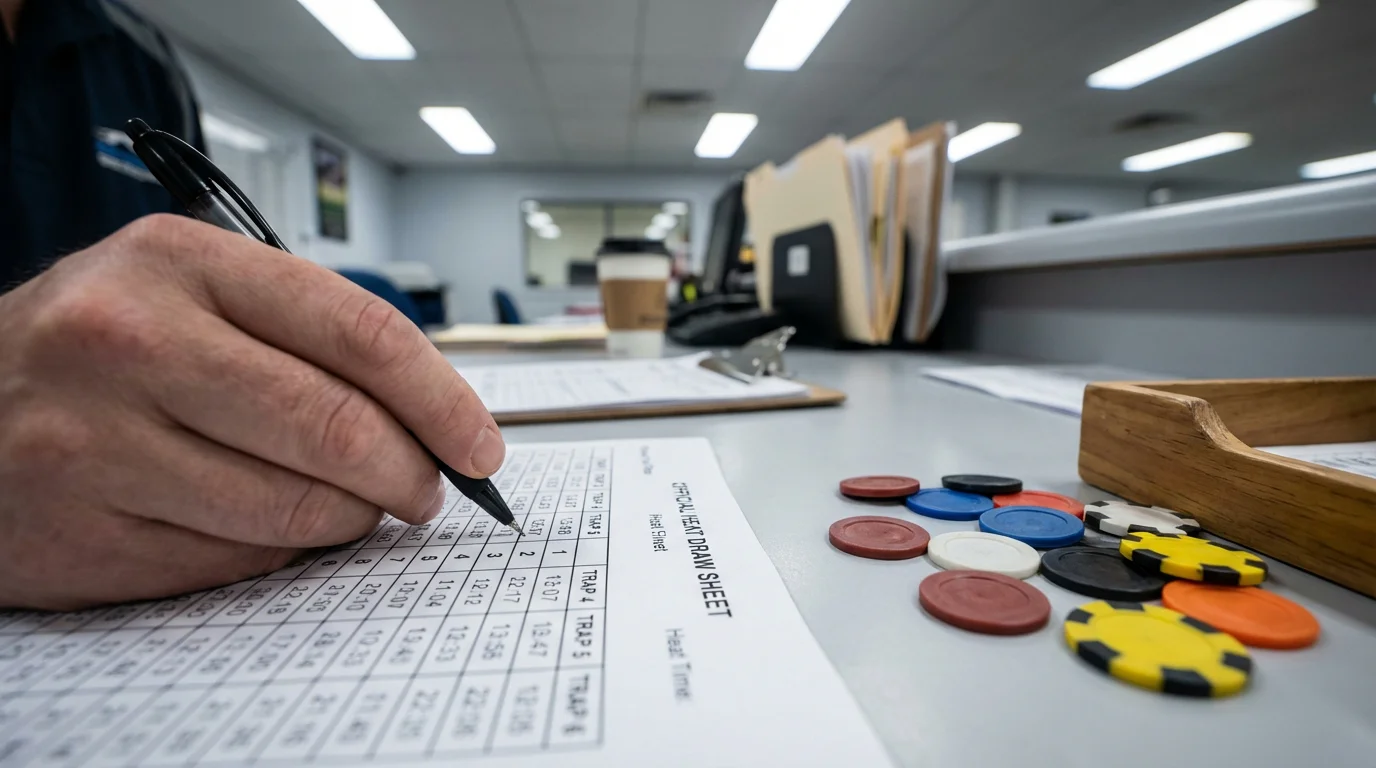
Under Rule 80, the draw sequence for an open race proceeds in stages. First, the unseeded runners — dogs without an established classification at the venue — are distributed across the heats. This is uncommon in the Derby, where trials establish seedings for virtually all entrants, but it covers the possibility. Next, railers are drawn sequentially into the available inside traps across all heats. The draw is randomised: the first railer drawn is allocated to the first available inside position in the first heat, the second to the first available inside position in the second heat, and so on, cycling through the heats until all railers are placed. Middle seeds follow the same process, then wide seeds.
The practical effect is that no trainer or connection can influence which heat their dog lands in or which specific trap it occupies. The draw is genuinely random within the structural constraints of the seeding system. A railer will always end up on the inside, but whether it lands in Heat 1 or Heat 32, alongside the ante-post favourite or a 200/1 outsider, is determined by the draw sequence alone.
Rule 80 also addresses the scenario where the number of entries does not divide evenly into six-dog heats. If the entry list falls short of filling every trap in every heat, the rule specifies how empty traps are distributed. In most Derby first rounds, the field is large enough that all traps are filled, but in years with lower entries, some heats may run with five dogs rather than six. The empty trap is typically on the outside — leaving Trap 6 vacant — which creates a structural advantage for the wide seed drawn into Trap 5, who now has clear space on both sides.
How the Rules Apply to the Derby
In the first round, Rules 76 and 80 operate in full. The approximately 192 entrants are seeded, distributed across 32 heats, and allocated to traps according to the inside-out sequence. The draw is the largest and most complex of the entire competition, and it produces the widest range of heat compositions. Some heats end up heavily weighted towards railers — four or five inside runners competing for three inside traps, with the overflow pushed into middle positions. Others are weighted towards wide seeds, creating a different dynamic entirely.
From round two onwards, the draw process repeats with a smaller field. The 96 qualifiers from round one are redrawn into 16 heats of six. The seedings carry over from round one unless the racing manager reclassifies a dog based on its round-one performance — which is rare but possible. The same inside-out allocation applies, and the same randomisation within categories determines which qualifier ends up in which heat.
By the semi-finals, only 12 dogs remain, split into two heats of six. The draw at this stage is pivotal because it determines not just the trap allocation but the composition of each semi-final. Two heats means two distinct competitive landscapes, and the draw decides which dogs face each other. A dog drawn into the weaker semi-final has a structural advantage over one drawn into the stronger contest, regardless of its specific trap position.
The final draw is the most scrutinised. Six dogs, six traps, one race. The seeding rules still apply — railers inside, wides outside — but the composition of the final six determines the practical outcome. If the final contains three railers and three wides, the allocation is clean: railers in 1-2-3, wides in 4-5-6. If the composition is two railers, three middles, and one wide, the middle seeds are pushed into higher traps than they might occupy in a balanced field, and the single wide seed ends up in Trap 6 with clear space on its outside. These compositional dynamics are the product of the rules, and reading them correctly is one of the most valuable analytical skills in Derby betting.
Edge Cases and Exceptions
The rules are clear in principle but occasionally produce outcomes that require closer examination. The most common edge case is the reclassification scenario. A dog that entered the Derby as a railer based on its trial performance might, after racing in the first round, demonstrate a preference for running wide. The racing manager has the discretion to reclassify the dog as a middle or wide seed for subsequent rounds. This reclassification changes the dog’s trap range for the rest of the competition — a former railer reclassified as a middle will no longer be guaranteed an inside trap. These reclassifications are announced before the next round’s draw and can catch bettors off guard if they assume the seeding is fixed for the duration.
Another edge case arises from reserve runners. If a dog is withdrawn between the draw and the race, a reserve may be called up to fill the vacant trap. The reserve takes the trap of the withdrawn dog regardless of its own seeding — a wide seed replacing a withdrawn railer would race from Trap 1 or 2, a position entirely at odds with its natural running style. These substitutions are uncommon but consequential when they occur, because the replacement dog is structurally disadvantaged and the heat dynamics change in ways the original draw did not anticipate.
Dead heats for qualifying positions create a procedural question that the rules address but bettors sometimes overlook. If two dogs dead-heat for third place in a heat — the last qualifying position — both progress to the next round under GBGB rules. This can create a round with more qualifiers than expected, and the subsequent draw must accommodate the additional runners. In practice, dead heats for third are rare but not unheard of, and their occurrence can affect the draw structure of the following round.
Finally, the rules make no distinction between UK-trained and Irish-trained dogs in the draw process. Irish entries are seeded, drawn, and allocated under exactly the same rules as their UK counterparts. The competitive dynamics of Irish runners in the Derby are significant — Ireland has dominated recent renewals — but the draw does not favour or disadvantage them relative to the domestic field. The only practical difference is that Irish dogs may arrive at Towcester with less venue-specific form, making their trial classification slightly more uncertain than that of UK dogs with established Towcester records.