Best Greyhound Betting Sites – Bet on Greyhounds in 2026
Loading...
Thirty Seconds of Market
A greyhound race lasts approximately 29 seconds. In-play betting on that race is, by any reasonable measure, an extreme form of live wagering. There is no half-time interval, no passage of play to analyse, no momentum shift to observe. The traps open, six dogs sprint towards the first bend, and the race is effectively decided within four seconds. Everything after that is a consequence of what happened in the opening phase.
And yet in-play betting on the Greyhound Derby exists, is offered by several licensed bookmakers, and is used by a significant number of punters. For some, it is an adrenaline product — betting on a race that is already happening, reacting to what they see on screen. For others, it is a calculated extension of pre-race analysis — a way to act on information that becomes available after the traps open but before the race concludes. Understanding the difference between those two approaches is the difference between entertainment and strategy.
How In-Play Greyhound Betting Works
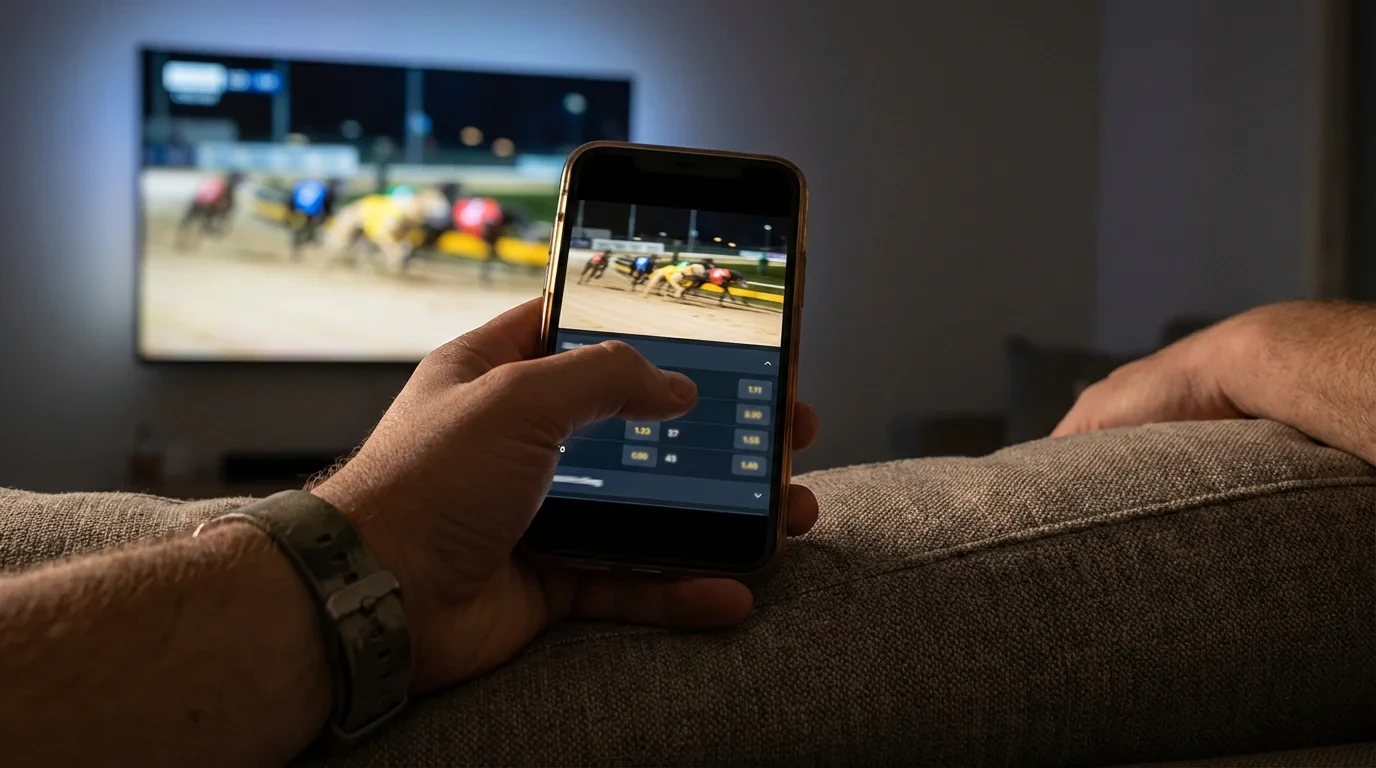
In-play betting on greyhound racing allows you to place bets after the traps have opened and the race is in progress. The odds update in real time — or as close to real time as the technology allows — based on each dog’s position during the race. A dog that breaks well and leads at the first bend will see its in-play odds shorten dramatically. A dog that is slow to emerge and trails the field will see its odds lengthen.
The mechanics vary by bookmaker. Some offer a dedicated in-play interface that displays live odds on each runner, with a brief betting window that opens when the traps spring and closes a few seconds before the finish. Others offer a simpler model: a cash-out option on pre-race bets that allows you to lock in a profit or cut a loss during the race itself. Both models are functionally in-play products, but they operate differently and require different approaches.
The critical constraint is time. A 500-metre greyhound race at Towcester takes approximately 29 seconds. The first bend is reached in roughly four seconds. By the time you have observed the break, assessed the first-bend dynamics, and decided whether to bet, the race is already more than half over. In-play greyhound betting is therefore not an analytical exercise in the traditional sense — it is a pre-programmed response. You decide before the race what scenarios would prompt you to bet in-play, and you execute that plan if and when those scenarios materialise. There is no time for deliberation.
This time constraint also affects the quality of the odds. Bookmakers know that in-play greyhound bettors have very little time to assess the market, and the in-play overround is typically higher than the pre-race overround. You are paying a premium for the ability to bet on live information, and that premium must be factored into any assessment of whether in-play betting offers genuine value or merely the illusion of it.
Available Live Markets
The range of in-play markets on greyhound racing is narrower than on sports with longer durations. The primary in-play market is the win market — betting on which dog will win the race. Prices update based on live positions, and you can back a dog that is leading or lay one that is trailing. Some bookmakers also offer in-play place betting, where you bet on a dog to finish in the first two or three.
Cash-out is the most widely used in-play feature in greyhound racing. If you have placed a pre-race bet on a dog that breaks well and leads at the first bend, the cash-out value of your bet increases immediately. You can close the bet at that point, locking in a profit without waiting for the finish. Conversely, if your selection breaks slowly, the cash-out value drops, and you can accept a reduced loss rather than watching the bet lose in full.
On betting exchanges, in-play trading is possible during greyhound races, though liquidity is limited. The exchange model allows you to both back and lay during the race, creating the possibility of trading in and out of positions for a guaranteed profit regardless of the outcome. In practice, the speed of a greyhound race makes exchange in-play trading extremely difficult — the odds move faster than most people can react, and latency between the live race and the exchange platform’s odds feed can mean that the price you see is already outdated by the time you submit your bet.
During the Derby specifically, in-play markets may be slightly deeper than on a standard racing night. The Derby attracts higher betting volume, which means more liquidity in both bookmaker and exchange in-play markets. Final night, in particular, generates the highest in-play turnover of any greyhound race in the calendar. But even on final night, the fundamental constraint remains: 29 seconds is not enough time for a deliberative in-play strategy. Everything must be planned in advance.
Strategies for Derby Live Betting
The only viable in-play strategies in greyhound racing are pre-planned responses to specific race scenarios. You cannot analyse the race while it is happening — it is too fast. You can, however, identify scenarios before the race that would change your assessment if they materialised, and prepare your response in advance.
The most common scenario is the cash-out decision. You have backed a dog at pre-race odds. The traps open and your selection breaks well, leading at the first bend. The cash-out value of your bet has increased significantly. Do you take it? The answer depends on your pre-race assessment of how likely the dog is to maintain its lead. If your analysis identified the dog as a strong front-runner with solid middle sectionals and no faster finisher behind it, letting the race play out is the higher-value option. If you identified the dog as a fast breaker that tends to tire — a dog whose first split is consistently faster than its finishing split — cashing out while it leads may be the sharper play.
A second scenario is the in-play back on a closer. If you have identified a dog with consistently strong finishing sectionals that tends to come from behind, you might wait to see whether it gets a clean run through the first bend before committing your stake. If it does — settling in third or fourth with clear running ahead — the in-play odds will be longer than the pre-race odds, because the market is reacting to its current position rather than its finishing speed. Backing the closer in-play at an inflated price captures value that the pre-race market had already priced in.
A third scenario is opposing a compromised leader. If a heavily fancied front-runner breaks slowly or encounters interference at the first bend, its in-play odds will lengthen. If you have identified this as a plausible scenario based on the draw — perhaps the dog was drawn between two other fast breakers, creating a first-bend duel — you can lay the favourite in-play at a longer price than its pre-race odds, capturing the probability of interference that the pre-race market underestimated.
All of these strategies share a common requirement: pre-race preparation. The in-play decision is made before the race. The in-play bet is merely the execution of that decision based on live confirmation of the anticipated scenario. Without preparation, in-play greyhound betting is reactive gambling. With preparation, it is a disciplined extension of your analytical framework.
Responsible In-Play Staking
In-play betting on greyhound racing carries specific risks that pre-race betting does not. The speed of the market, the emotional intensity of watching a live race, and the availability of instant cash-out options create conditions that can lead to impulsive decisions. Managing those risks is not optional — it is a structural part of any in-play strategy.
The first discipline is stake sizing. In-play stakes should be pre-determined, not decided in the moment. If you plan to cash out a pre-race bet, know in advance what cash-out level you will accept. If you plan to back a closer in-play, allocate a specific stake before the race starts and do not increase it based on what you see during the race. The emotional response to a live race — excitement when your dog leads, frustration when it trails — is not a reliable guide to staking decisions.
The second discipline is frequency control. The Derby involves multiple races per evening across several weeks. The temptation to bet in-play on every heat is real, particularly on first-round nights when 10 or 12 heats are contested in a single session. Resist it. In-play betting should be reserved for specific scenarios where your pre-race analysis identified a clear trigger, not applied indiscriminately as a way to stay engaged with every race.
The third discipline is recognising the product for what it is. In-play greyhound betting is, for most people, primarily an entertainment product. The time constraints, the overround premium, and the difficulty of executing in-play decisions at speed mean that the expected return on in-play betting is lower than on pre-race betting for the average punter. If you use it as entertainment, budget for it as entertainment. If you use it as a strategic tool, limit it to the small number of scenarios where pre-race preparation gives you a genuine informational edge over the live odds. The gap between those two approaches is the gap between recreation and discipline, and being honest about which category your in-play activity falls into is the most important responsible gambling decision you can make during the Derby.