Best Greyhound Betting Sites – Bet on Greyhounds in 2026
Loading...
The Price Is Only Half the Story
Odds are the language of betting. They tell you what the market thinks will happen, how much you stand to win, and — if you know how to read them — where the market might be getting it wrong. In the context of the English Greyhound Derby, odds are published months before the final and change continuously as information enters the market. Understanding what those numbers mean, how they are set, and why they differ between bookmakers is not optional. It is the minimum requirement for betting with any discipline.
The Derby produces a uniquely volatile odds environment. Prices shift after entries, again after trials, again after each draw, and again after every round of racing. A dog that opens at 20/1 in the ante-post market can be 5/2 favourite by the semi-finals — and the Derby’s history shows this pattern repeatedly. Reading odds in this context means tracking movement, not just recording a snapshot.
This guide covers the basics of how greyhound odds work, how bookmakers construct Derby markets, and — most importantly — how to identify the gaps between what the odds say and what the evidence suggests.
Fractional vs Decimal Odds
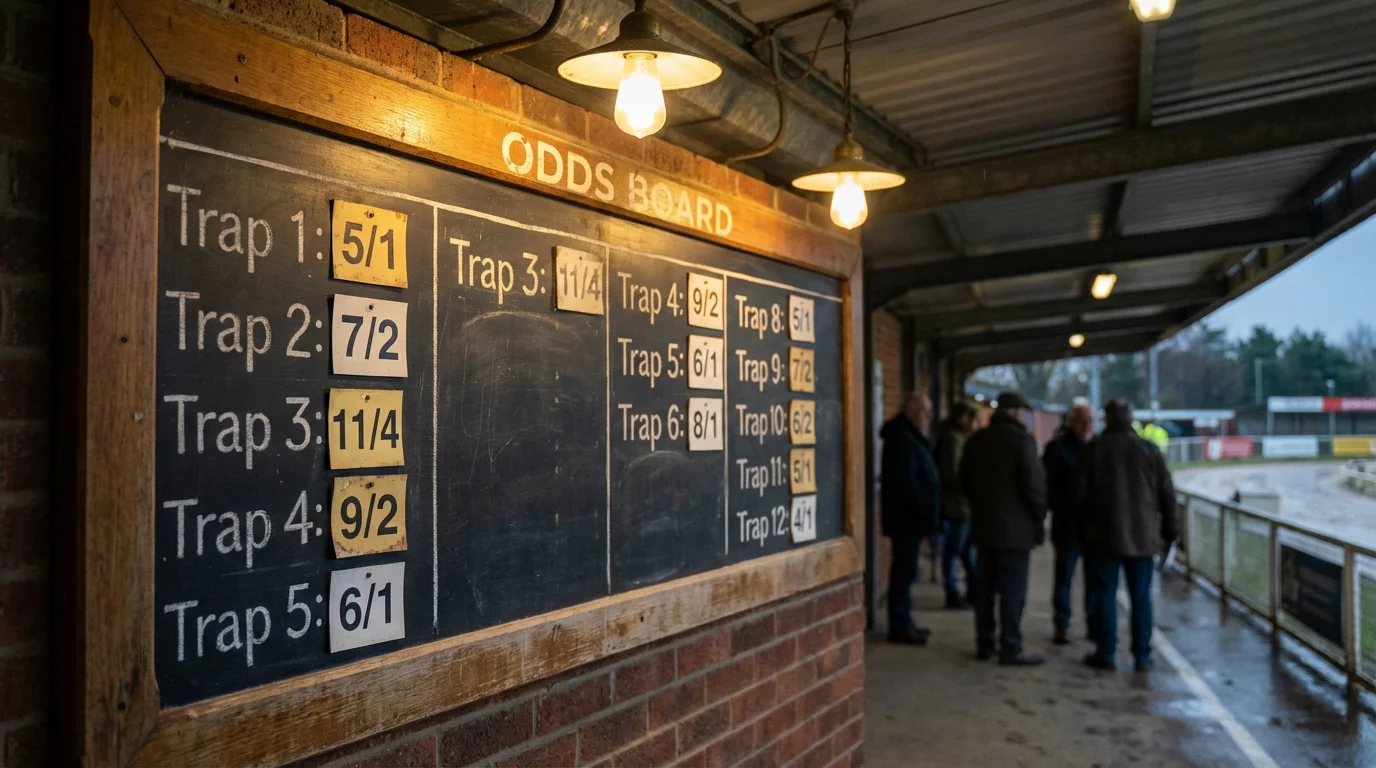
British greyhound racing predominantly uses fractional odds — the format you see as 5/1, 11/4, or 2/1. The first number is the profit relative to the second number as stake. At 5/1, you win five units for every one unit staked. At 11/4, you win eleven units for every four staked. The total return includes your stake, so a winning 5/1 bet with a one-unit stake returns six units in total.
Decimal odds, standard across continental Europe and increasingly used by online bookmakers, express the total return per unit staked. A 5/1 fractional price converts to 6.00 decimal. An 11/4 price converts to 3.75. The decimal format is mathematically simpler — multiply your stake by the decimal price to get your total return — and it makes comparing prices across bookmakers faster, because you are comparing a single number rather than a fraction.
For Derby betting, where you may be comparing prices across four or five bookmakers before placing a bet, decimal odds are more efficient for quick comparison. Most UK bookmakers offer both formats in their settings. Switch to decimal when you are price-shopping, switch back to fractional if you prefer the traditional format for placing the bet itself. The odds mean exactly the same thing either way — the format is a presentation choice, not a value difference.
One subtlety worth noting: fractional odds in greyhound racing sometimes use non-standard fractions that are harder to compare. An 11/8 price is common in greyhound markets but less intuitive than the equivalent 2.375 in decimal. A 6/4 price (decimal 2.50) might be offered by one bookmaker while another offers 13/8 (decimal 2.625) on the same dog. In fractional format, spotting that 13/8 is the better price requires mental arithmetic. In decimal, 2.625 is obviously larger than 2.50. Use whichever system makes comparison easiest for you.
How Bookmakers Set Derby Odds
Bookmaker odds are not predictions. They are prices designed to attract balanced action while building in a margin that ensures the bookmaker profits regardless of the outcome. Understanding this distinction is fundamental to reading any market with clarity.
Derby odds begin as a trader’s assessment of each dog’s chance of winning the final. The trader considers form, trainer record, trial data, historical trends, and — once available — the draw. These assessments are converted into probabilities, then adjusted to include the bookmaker’s overround. The overround is the margin built into every market: if you add up the implied probabilities of all runners in a six-dog final, they will sum to more than 100%. The excess — typically 10% to 20% in greyhound racing — is the bookmaker’s edge.
In the ante-post phase, Derby odds are set with wider margins because the uncertainty is greater and the volume of bets is lower. A bookmaker pricing up 20 potential Derby contenders three months before the first round is making rough assessments with limited information. As the competition progresses, information enters the market — form, draw results, round-by-round performances — and the odds tighten. By final night, the market on the six finalists is relatively efficient, with overrounds in the 110-115% range, comparable to a horse racing handicap.
The key insight for bettors is that Derby odds are most vulnerable to error in the early and middle stages. Ante-post markets are priced by generalists who may not have deep knowledge of greyhound form. First-round markets are priced in volume — 32 heats, each requiring individual attention — and mistakes are inevitable. The further you move from the final, the wider the pricing errors are likely to be, and the greater the opportunity for an informed bettor to find value.
By contrast, the final market is typically well-priced. Six dogs, extensive media coverage, and concentrated betting volume mean that the market has absorbed most available information. Value in the final tends to come not from bookmaker error but from disagreements about how to weight the draw — specifically, whether a particular trap allocation helps or hurts a given dog more than the market believes.
Comparing Across Bookmakers
Price comparison is the simplest and most reliable way to increase your returns in Derby betting. The same dog, in the same heat, on the same night, can be priced at 3/1 with one bookmaker, 7/2 with another, and 10/3 with a third. These are not trivial differences. Over a full Derby campaign, consistently taking the best available price rather than the first price you see can add 10% to 15% to your total returns without changing a single selection.
Odds comparison sites aggregate prices from multiple bookmakers in real time, and most cover greyhound racing markets including the Derby. The process is straightforward: identify your selection, check the comparison site, place your bet with the bookmaker offering the highest price. This takes an extra thirty seconds per bet and is worth doing on every single wager.
The differences between bookmakers are especially pronounced in the ante-post phase and in first-round heats. Ante-post prices reflect each bookmaker’s individual trader assessment, and these assessments can diverge significantly when information is scarce. In first-round heats, some bookmakers price more aggressively on favourites while others maintain wider margins across the board. A dog offered at 4/5 by a bookmaker that shortens favourites heavily might be available at evens or 11/10 with a bookmaker that prices more conservatively.
Enhanced place terms and promotional offers add another layer. During the Derby, several bookmakers run promotions — extra places on each-way bets, boosted odds on selected runners, or money-back specials on certain outcomes. These promotions have genuine value when they align with bets you would place anyway. They have no value if they tempt you into bets you would not otherwise make. The discipline is to treat promotions as a bonus, not a reason — your selections should be driven by analysis, with the promotion as a secondary factor that might influence which bookmaker you place with rather than what you place on.
One practical note: maintain accounts with at least three or four bookmakers that cover greyhound racing in depth. Not all bookmakers price every Derby heat, and those that do may vary in the speed at which they publish prices. Having multiple accounts ensures you can always access the best available price and take advantage of the market’s brief inefficiencies after draw announcements.
When Odds Do Not Reflect Reality
The market is a tool, not an oracle. Derby odds reflect the collective assessment of bookmaker traders and the weight of money from bettors — but collective assessment can be wrong, and the weight of money can be driven by sentiment rather than analysis.
The most common scenario where odds fail to reflect reality is after a headline performance in the early rounds. A dog that records a fast time in round one shortens dramatically for the outright market, even if the time was achieved against weak opposition in easy conditions. The market overweights the most recent, most visible data point and underweights context. This creates both sides of the value equation: the impressive performer is now overpriced relative to its true chance, while less flashy dogs that qualified from tougher heats are underpriced.
Another scenario is the draw reaction. When the draw is published, the market moves quickly — but not always accurately. A dog that draws Trap 1 might shorten because the market associates the inside box with an advantage, even though Trap 1 historically underperforms in Derby finals. Conversely, a wide seed that draws Trap 6 might drift because casual bettors associate the outside with a disadvantage, even though Towcester’s geometry suits wide runners. These are systematic biases in how the market processes draw information, and they create repeatable opportunities for bettors who understand the venue-specific data.
The practical rule is to treat odds as the market’s hypothesis, not its conclusion. When your analysis disagrees with the price, and your analysis is based on data rather than instinct, the odds are telling you where the value is. The market is efficient enough to be right most of the time. But in the Derby — with its thin liquidity, reactive pricing, and multi-week narrative arc — it is wrong often enough to reward the bettor who can see what the price does not show.