
The Variable Nobody Controls
You can analyse the form, study the draw, and model the first-bend dynamics. You cannot control the weather. The English Greyhound Derby is held across five weekends in late May and June — prime British summer, which means anything from warm sunshine to persistent rain and everything in between. The conditions on race night affect the track surface, which affects running times, which affects the performance of every dog on the card. Two dogs of identical ability running on the same track a week apart can produce times that differ by 0.30 seconds or more, purely because the going changed between rounds. Get more race analysis at greyhoundderbydraw.
For bettors, weather and track conditions are the most underappreciated variable in Derby analysis. The market reacts strongly to times and form but often fails to adjust adequately for the going. A dog that runs 28.60 on fast sand is not the same proposition as one that runs 28.60 on a heavy, rain-soaked surface — the second performance may represent a significantly higher level of effort and ability. Understanding how weather affects Towcester’s sand track, and how to adjust your assessments accordingly, is a genuine analytical edge.
How Weather Affects Sand Tracks
Towcester’s racing surface is sand — a granular material whose physical properties change measurably with moisture content. Dry sand is loose and gives way under a greyhound’s paws, absorbing some of the force that would otherwise propel the dog forward. Damp sand is firmer, providing a more solid base for each stride and allowing the dog to transfer more energy into forward motion. Very wet sand becomes heavy and clings, creating drag that slows every stride.
The optimal surface condition for fast times is moderately damp — firm enough to provide a solid base, moist enough to hold together, but not so wet that it creates drag. Track staff at Towcester manage the surface throughout the meeting, watering it before racing begins and adjusting moisture levels between races. But they cannot counteract heavy rain during the card, extended dry spells that dry the surface beyond its optimal range, or rapid temperature changes that affect evaporation rates.
The practical consequence is that the going at Towcester varies from night to night and sometimes from race to race within a single meeting. A first-round heat on Thursday evening may be run on fast going after a warm, dry day. A heat on Saturday evening, after two days of rain, may be run on significantly slower going. Both heats are official Derby races, and the dogs that qualify from both advance on equal terms — but the times they recorded are not directly comparable without a going adjustment.
Track condition reports are published before each meeting, usually described using terms like “fast,” “standard,” “slow,” or “heavy.” These reports are useful as broad indicators but lack the precision that bettors need for detailed time comparison. The most reliable approach is to watch the early races on each night and note the times relative to known benchmarks. If the early graded races are producing times 0.10 to 0.15 seconds slower than the same dogs ran the previous week, the going has slowed, and your time expectations for the Derby heats should adjust by a corresponding amount.
Rain and Its Impact on Times
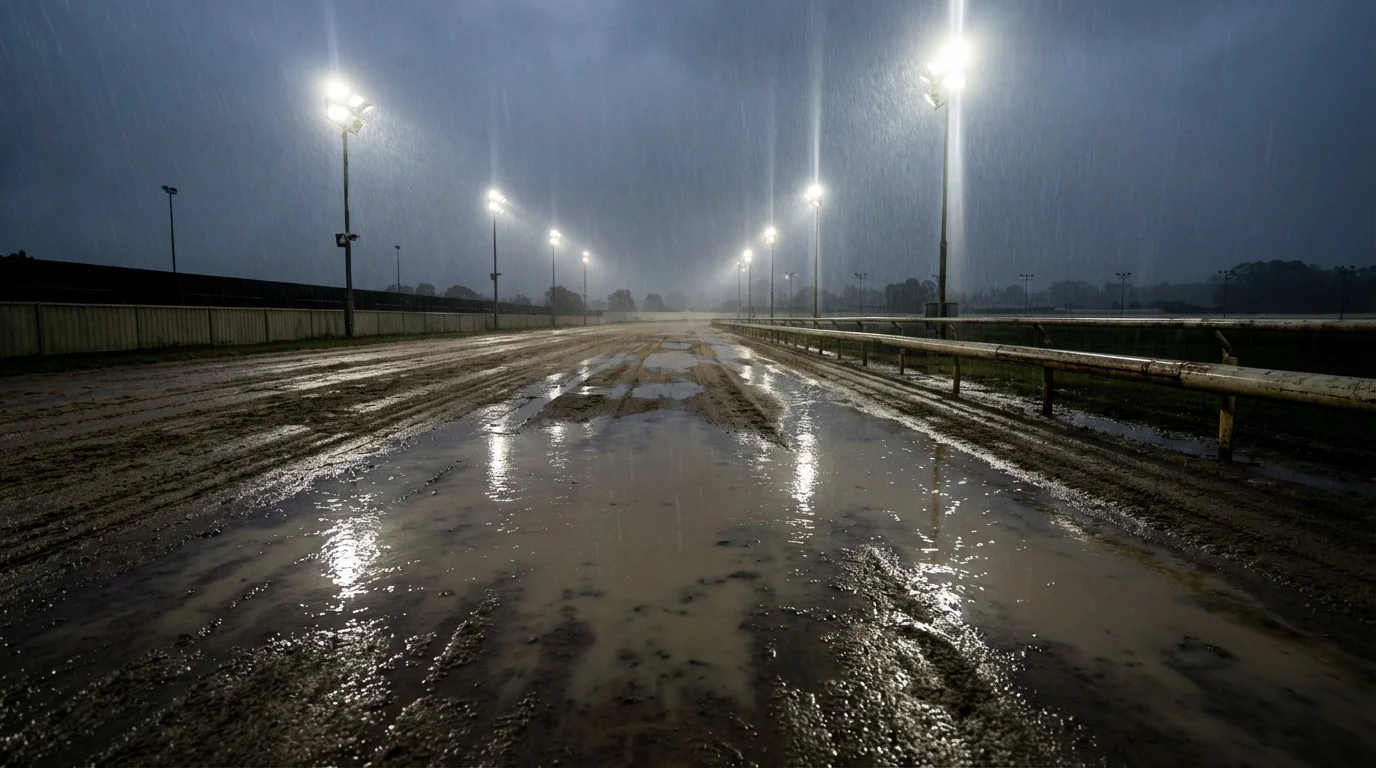
Rain is the most significant weather variable at Towcester. Light rain before racing may actually improve the going, adding moisture to a surface that had been too dry. But sustained rain during a meeting progressively slows the track, and heavy downpours can transform the surface from fast to heavy within the space of an hour.
The effect on times is consistent: rain slows the track. A meeting that begins in 28.60 territory may end in 29.00 territory if rain falls steadily throughout the card. Dogs that race in earlier heats on a rainy evening have a surface advantage over those that race later, because the track deteriorates progressively. In the first round, where heats are spread across three nights, a Thursday evening of dry racing followed by a Saturday evening of rain can produce a time differential of 0.20 to 0.30 seconds between equivalent performances — a difference that is entirely attributable to the going and not to the dogs.
Rain also affects the racing dynamics beyond raw times. Wet sand offers less grip, particularly on the bends, and dogs may struggle to maintain their running line through turns. Wide runners, who cover more distance on each bend, suffer disproportionately because they spend longer on the curved sections where grip is most compromised. Inside runners benefit marginally, because their tighter line involves less distance on the slippery bend surface. These grip effects are small but consistent, and on a very wet night they can shift the balance of advantage between traps by a measurable amount.
Spray is another consideration. Dogs running behind the leaders on a wet surface receive kickback — sand and moisture thrown up by the dogs in front. This spray can affect visibility and breathing, and some dogs respond to it by dropping further back or shifting their running line to avoid the worst of it. A dog that races prominently in dry conditions may settle further back on a wet night, producing a running style that looks different from its usual profile. If you are interpreting form from a wet-weather round, account for the possibility that the dog’s position through the race was influenced by conditions rather than by a change in ability or tactics.
Temperature and Greyhound Performance
Greyhounds are athletic animals operating at near-maximum physical capacity, and temperature affects their performance in ways that are measurable but often overlooked by bettors.
Warm conditions — above 20 degrees Celsius — can impair greyhound performance through heat stress. Dogs generate significant body heat during a sprint, and their ability to dissipate that heat is limited. Panting is their primary cooling mechanism, and in warm, humid conditions, it is less effective. The result is that dogs may tire more quickly in the closing stages of a race, producing slower finishing splits and a marginal decline in overall time. The effect is modest — perhaps 0.05 to 0.10 seconds over 500 metres — but in a sport decided by fractions, it matters.
Cool conditions — below 10 degrees — may have the opposite effect, allowing dogs to maintain their body temperature more efficiently and potentially producing slightly faster times in the closing stages. However, very cold conditions can also cause muscle stiffness, particularly in the early strides out of the traps, which may impair first-split times. The net effect of cold weather is less consistent than the net effect of heat, and it is harder to model reliably.
The Derby’s late-May and June timing means that most racing takes place in moderate temperatures — typically between 12 and 22 degrees in the evening. Extreme conditions are rare, but they do occur. An unusually warm early-June evening can produce slower final times across the card, and bettors who do not account for the temperature will misjudge the form of dogs that raced on that night.
Wind is a secondary temperature-related factor. Towcester’s Northamptonshire location is relatively exposed, and a strong headwind on the finishing straight slows times by creating aerodynamic drag that dogs running at 60 kilometres per hour cannot ignore. A tailwind on the same section can aid closing speed. Wind conditions are rarely reported in greyhound racing coverage, but they can account for time differences of 0.05 to 0.10 seconds between otherwise identical performances. If you are trackside, note the wind direction and strength. If you are watching remotely, check the weather data for the Towcester area around race time.
Adjusting Bets for Conditions
The practical application of weather analysis in Derby betting is time adjustment. Every time comparison you make between dogs — whether across different heats in the same round or across different rounds in the competition — should include a going correction. Without that correction, you are comparing numbers that were produced under different conditions and treating them as if they are equivalent. They are not.
The simplest adjustment method is relative comparison within each card. If the early graded races on a given night are running 0.15 seconds slower than the same dogs ran the previous week, apply a 0.15-second correction to all times from that meeting. A dog that ran 28.80 on the slower night was running the equivalent of approximately 28.65 on the faster surface. This is a rough adjustment, but it is far more accurate than making no adjustment at all.
A more sophisticated method uses the average time differential across a full night of racing. Compare the average finishing time across all races on night one with the average on night two and night three. The differential gives you a card-level going correction that accounts for the cumulative effect of conditions across an entire evening, rather than relying on a single reference race.
Going adjustment also affects how you assess dogs’ prospects in future rounds. If a dog qualified from round two on heavy going with a time of 29.05, and round three is forecast to be run on fast going, the dog’s likely round-three time is not 29.05 — it is faster, perhaps significantly so. The going forecast for each round of racing is therefore a useful input when pricing your pre-draw positions. If the forecast suggests fast going for the semi-finals, dogs that have raced well on fast going in earlier rounds are at an advantage relative to those whose best times came on slower surfaces. Also read our greyhound racing sectional times.
One final point: conditions affect dogs unevenly. Some dogs handle heavy going better than others, just as some handle heat or cold better. Over the course of a five-round campaign, you accumulate data on each surviving dog’s going preferences. A dog that runs its best sectionals on fast going but fades on heavy going has a weather dependency that should be factored into your assessment whenever conditions change. The weather is the one variable you cannot predict or control. But you can measure its effect, adjust for it, and use that adjustment to see through the noise that conditions create in the raw time data.
